Share
Print

How Benjamin Swig’s personal mission of tikkun olam, or “repairing the world,” shaped Santa Clara University

Why would a Jewish man invest so much in a Jesuit Catholic school? Swig had many reasons.
19 Nov 2026
by Nic Calande
A sepia toned photograph from The Redwood yearbook of Benjamin Swig holding a puppy.A sepia toned photograph from The Redwood yearbook of Benjamin Swig holding a puppy.
Image courtesy Santa Clara University Archives & Special Collections.

There’s a 16th-century Kabbalah story about how the world began: God poured primordial divine light into vessels meant to hold it, and the vessels shattered. Sparks of holiness scattered everywhere, hidden inside an ordinary, broken world. Nobody chose to be born into the wreckage, but every act of righteousness, or mitzvah, is a small act of gathering—one spark retrieved, one fragment restored.

This work of a lifetime, called tikkun olam in Hebrew, or “repairing the world,” is not a metaphor for being nice when you can spare it. The word most often translated as “charity,” tzedakah, shares its root with tzedek, or “justice,” implying that charity isn’t optional kindness given from a position of comfort. It’s an act of reparation, a debt we are all expected to repay.

Benjamin Swig came to understand this mission intimately through a career of highs and lows.

His father, Simon, a Jewish immigrant from Lithuania, worked his way up from nothing, becoming a successful banker and state legislator in Massachusetts. Swig inherited his father’s knack for business. In fact, family lore has it that by age 10, young Ben would regularly ride a commuter train into Boston to sell newspapers before school.

But comfort didn’t protect him from loss. While Swig was serving as its treasurer, his family’s bank collapsed in the early 1920s following a retaliatory run by rival bankers. Then Swig pivoted to real estate—only to be wiped out again by the 1929 crash. He built his firm back a second time, eventually owning San Francisco’s famed Fairmont and St. Francis hotels.

While he came from wealth, losing and rebuilding everything twice seemed to leave him with an unusual amount of gratitude and perspective, drawing him toward civic and philanthropic causes, both Jewish and non-Jewish alike.

So, in 1959, when Santa Clara University’s president, Patrick Donohoe, S.J., asked Swig to join the University’s first Board of Regents, what followed was a transformative relationship between the hotelier and the University, which Swig described as his “greatest love.” Over the next 20 years, Swig gave Santa Clara more money and time than any volunteer in its history, almost single-handedly bankrolling the campus building boom of the 1960s while declining to stamp his name on any of it.
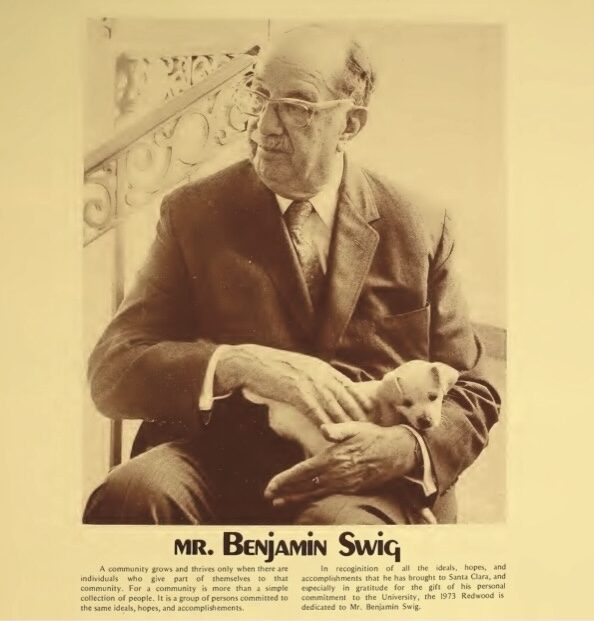
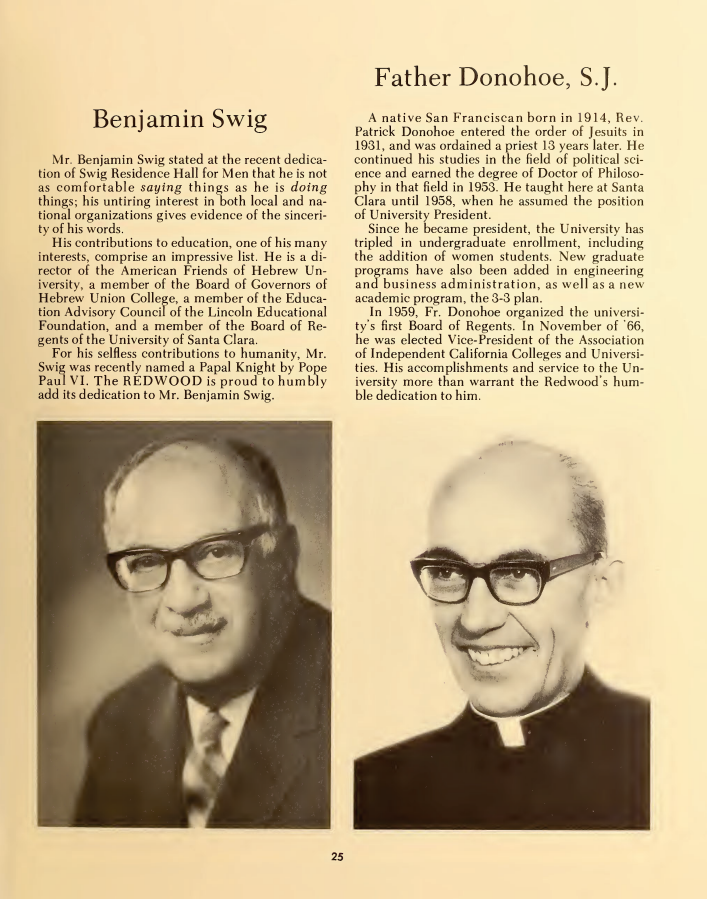
A Redwood yearbook page featuring photos of two blad men with glasses, Benjamin Swig and Father Donohoe.A Redwood yearbook page featuring photos of two blad men with glasses, Benjamin Swig and Father Donohoe.
Benjamin Swig (left), appointed to Santa Clara’s first Board of Regents by then University President Patrick Donohoe, S.J. (right), preferred to act rather than talk, according to The Redwood’s 1973 yearbook dedication. Image courtesy SCU Archives.

In fact, the residence hall that now bears his name was a fait accompli: Donohoe built it without Swig’s money and dedicated it to him anyway, telling Swig that since he hadn’t funded that dorm, he had no say in its name. Swig’s reply was a check for $6 million more.

But Swig didn’t just invest in buildings—he invested in students, often inviting those with grievances up to his own apartment for dinner rather than brushing them off, delighted to connect with the young people he was building it all for.

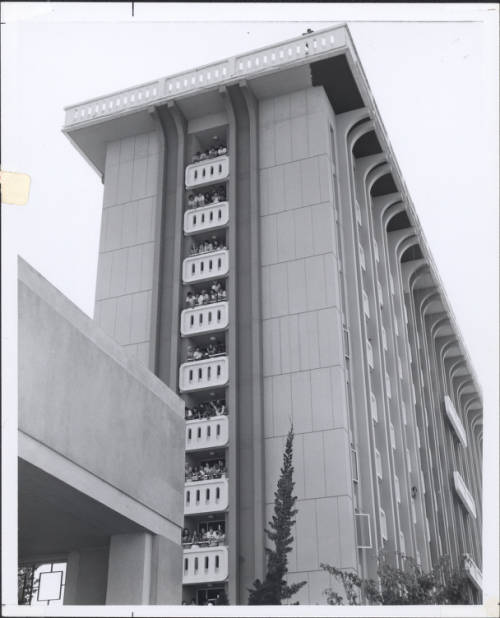
people crowd the balconies on the side of a tall building with a unique curved, flat roof.

Students crowding the balconies on the side of Swig Hall, circa 1977. Photo courtesy SCU Archives.

Late in life, Swig used his Santa Clara connections to secure a scholarship for Gordon Belcourt ’68, a young Blackfeet Nation member. After earning a master’s degree in public health at the University of California, Berkeley, Belcourt later became the executive director of the Montana-Wyoming Tribal Leaders Council, securing over $5 million in grants to counter alcohol abuse. Thousands of lives changed, all from one opportunity.

If you’re wondering why a Jewish man would invest so much in a Jesuit Catholic school, according to Swig’s great-grandson Lucas Heldfond, the affinity for Santa Clara may have been precisely because of Swig’s Jewish faith.

“The bridge from tikkun olam to the Jesuits is that a service of faith is inseparable from the promotion of justice,” Heldfond explains. “The Jesuit call to seek a greater good, magis, resonated with him deeply. It encouraged him to think beyond what was comfortable and toward what was right.”

At Santa Clara, magis, or “more,” is sometimes talked about as “being men and women for and with others.” And certainly, if anyone embodied this common call across two faiths, it was Swig.

Both traditions treat the world as unfinished by design. Both insist ordinary people—not saints, not the chosen—are responsible for the finishing. And both refuse to let the spiritual stay private: A mitzvah and an act of magis are only real once they land on someone else.

“His belief in education was really a belief in human potential,” explains grandson Steven Swig J.D. ’69. “He felt that when people are given room to grow—intellectually, spiritually, and personally—they can surprise even themselves with what they contribute to the world. When you lift up a student, you lift up the communities they will one day serve.”

Thus, money given away is not lost. It’s a gathering of sparks, a sacred repair best done with warm hands, not cold.

He put it plainly himself, in 1975: “I think that God’s been good to me, and so I want to pay my debt to Him and to humanity while I’m on Earth … I don’t want to wait. It has to be now. In this world.”

Four generations later, his family is still repairing the world in Swig’s honor, aligning Jewish and Jesuit traditions most recently through a new Santa Clara scholarship for first-generation students.

“Academic excellence can be your lighthouse,” says great-granddaughter Casey Swig-Sedlack. “But what gives that light purpose are the values that shine through. Let’s not only see the good in the world. Let’s make a personal choice to create more of it.”