The awesome thing about making your own instruments, especially in code, is there’s just so many things you can do. There’s so many different combinations.
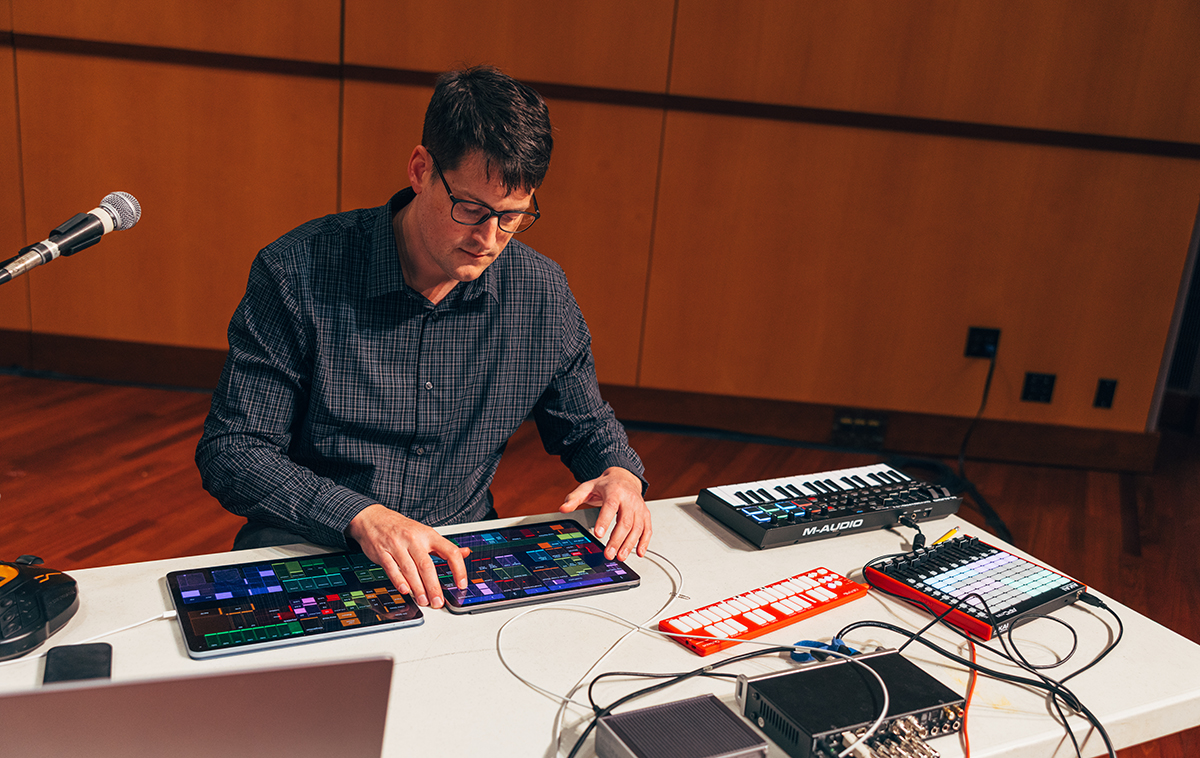
I make music that is visceral, physical interaction between computers and usually live performers. What I do is take microphones and put them on the musicians. So if I’m playing with a trumpet player, I’ll put a microphone on the trumpet or a piano, and I grab their sound, and the sound goes into the computer. I’ve developed a whole system of processing techniques where I take their sound and I manipulate it, and I mix it up and do crazy things with it, and then send it out to speakers. What I’m trying to do is create a reactive environment between me and my computer and an acoustic instrumentalist.
Making music, to me, is religion. I like sitting in a room and composing something. But what I really like is working with other humans and creating something—and through that interaction, developing really deep connections. I recently wrote a piece for [Santa Clara music Professor] Teresa McCollough. I have known her for 25 years. She was my first music teacher here. I wanted to write a piece that she would enjoy playing and that would become a communication between us and with the audience. It was a great experience.
Santa Clara is where I wrote my first piece of music. I took a mathematical process, and I turned it into a woodwind trio. It’s those kinds of connections that you can make here: studying something in class and then applying it to a piece of music. It can really help you find your purpose. I came here as a computer science major, but then I discovered this wild love for music.