With the Mark & Mary Stevens School of Medicine, a collaboration between Sutter Health and Santa Clara University, on the horizon, another part of the University’s health ecosystem is already growing through the Bronco Ventures Accelerator. This program, offered by the Ciocca Center for Innovation and Entrepreneurship, supports founders as they grow their businesses and pursue professional mentorship and investment.
Over the last four years, the accelerator has seen an increase in medical and healthcare startups, with participants creating companies to advance everything from metabolic measurement technology to pharmaceutical drug development.
“Our biggest vertical in the accelerator has been medical startups, as we’ve seen many Broncos interested in the intersection of entrepreneurship and medicine,” says Cristina Cismas Florea ’05, MA ’07, assistant director of the Bronco Ventures Accelerator. “Bringing these two pathways together could establish Santa Clara as a community where people can pursue different paths in medicine, whether they come to the medical school to be physicians or researchers, or entrepreneurs or investors.”
Founded in 2019, the Bronco Ventures Accelerator connects alumni and faculty founders with a network of more than 2,000 mentors, investors, and industry experts as they prepare their businesses for financial investment. Startups supported by the accelerator have collectively raised more than $100 million dollars since its inception.
Now in its eighth cohort, the program selects new founders through a competitive application process, bringing them together on campus for an intensive 16-week experience that includes expert speaker panels and networking events. Participants meet with mentors and attend workshops in preparation for Demo Day, a Shark Tank-style pitch competition where they have the opportunity to present their businesses to hundreds of investors, many of whom are Santa Clara alumni, during Grand Reunion.
“Broncos come back to campus to give to other Broncos, so it creates an amazing community of giving,” Florea says. “It really ties into the Jesuit vision and mission that we have at Santa Clara—excellence in technology and industry, with empathy and mission-guided values to help society.”
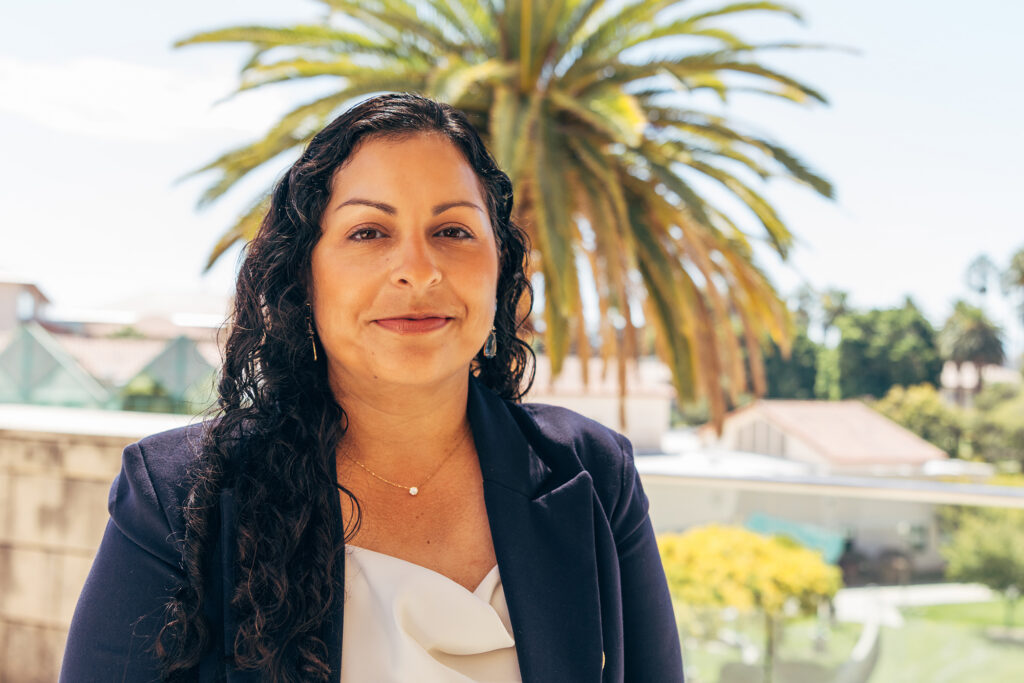
That community has helped alumni founders like Anne Scholz MBA ’93 tackle real challenges in healthcare. A member of the accelerator’s sixth cohort, Scholz co-founded RealSeq Biosciences, a company that develops tools to help researchers analyze RNA molecules and identify signs of disease in the body.
Shortly after graduating from Santa Clara, Madeleine Eiken ’19 joined the accelerator with her company, Intero Biosystems, which grows miniature human organs in labs to test new drugs. Through the program, she learned foundational skills for running a successful business, including how to pitch and market her company, and went on to raise more than $2 million in funding to continue its development.
Faculty from the University have also gone through the accelerator to move their research from the lab into the marketplace. Among them is Hari Mix, a former assistant professor of environmental studies and sciences and geochemist, who joined the Bronco Ventures Accelerator with his company, Calorify. The business grew from a surprising real-world application of the research he was doing at Santa Clara and his athletic background.
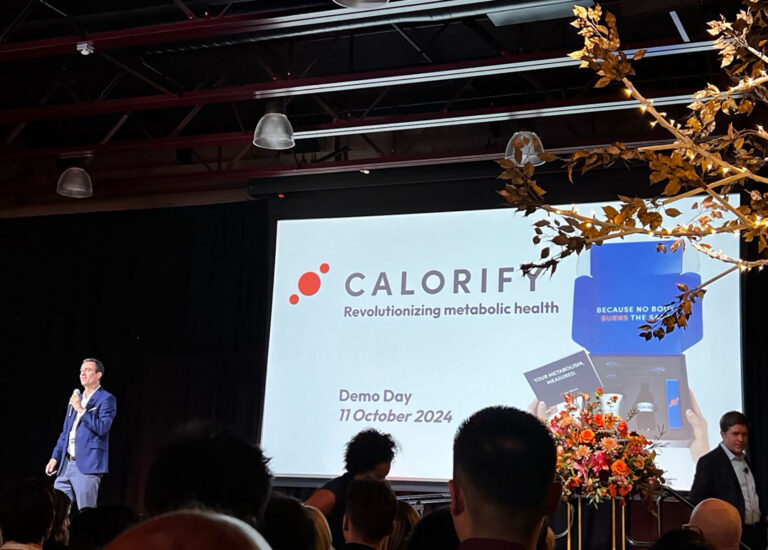
Hari Mix presents his company, Calorify, to an audience of investors and entrepreneurs at Santa Clara University’s sixth annual Bronco Ventures Demo Day in 2024.
While teaching at Santa Clara, Mix developed a stable-isotope lab to study the Earth’s natural environmental processes using rare forms of hydrogen, oxygen, and carbon. That same expertise would eventually prove to be useful in a very different venture: measuring how much energy a person’s body actually uses every day.
Mix was already familiar with two ways of determining daily energy expenditure. The more common approach uses a mathematical equation to estimate how many calories a person burns based on factors like age, weight, and activity level. A more precise method uses doubly labeled water, which contains heavier-than-usual forms of hydrogen and oxygen that scientists can track by collecting urine samples from the body. By comparing how fast the two isotopes leave the body, they can figure out how much carbon dioxide the body produces and calculate exactly how many calories a person burns.
For decades, this method was largely confined to research settings because it was expensive, complicated, and time-consuming, putting it out of reach for most people. Mix wanted to make the technology more accessible.
Building Calorify from the ground up
An avid distance runner and mountain climber, Mix had taken on some of the world’s highest peaks during demanding, multi-month treks in places like Nepal and Pakistan, where the extreme conditions repeatedly took a toll on his body and overall physical health.
“On these trips you end up losing a ton of weight, and usually it’s not good weight. The conditions are very harsh, and you can hardly eat at extreme altitudes, if you can eat at all,” Mix explains. “By doing repeated expeditions, I went through this rinse-and-repeat cycle of stripping off lean body mass, getting into some type of metabolic crisis, and then doing it again and again. I’ve long been interested in making those trips healthier so I can perform better on them.”
Mix began using doubly labeled water on his expeditions to understand exactly how much energy he was burning so he could take preventative measures to better fuel his body. While climbing Manaslu, the eighth-highest mountain in the world, he combined the water testing with other nutritional approaches. He only lost three pounds of lean mass and eight pounds of fat, a significant improvement compared to other treks where he shed closer to 25 pounds.
The more he used the technology, the more he wondered why it wasn’t available for the masses.
“I just kept thinking, this is too good and too useful. How come this hasn’t made it to the world? I wanted to make a company that made at-home kits with a fast turnaround—and a lot cheaper. That’s what we did at Calorify,” says Mix, who founded the company in 2021.
Today, Calorify works with both professional athletes and medical researchers. The company has partnered with the San Antonio Spurs, Oklahoma City Thunder, and Atlanta Hawks, using its testing to create personalized energy budgets that help the players better understand their nutrition and training needs. Calorify’s testing is also used in clinical trials involving the development of obesity and diabetes medicines.
The broader goal, Mix says, is to improve global metabolic health.
Coming full-circle with Bronco Ventures
By the time Mix joined the Bronco Ventures Accelerator, Calorify was already up and running. He had raised its first round of funding, hired a team, built a lab, and generated revenue. Bronco Ventures contributed to Calorify in its second round of funding and invited Mix to join the accelerator’s next cohort.
Having left Santa Clara a few years earlier to found Calorify, Mix says returning to participate in the accelerator was a full-circle experience.
“The best aspect of the experience was the energy of being with a group of people all fired up about what they’re building, all bouncing ideas off each other and helping each other. The mentorship from the Bronco Ventures Accelerator team was exceptional. It lined up really well with where we were as a company and what we needed to do next,” Mix says.
After leaving the accelerator, Calorify went on to hit several notable milestones, including serving a clinical trial for a new obesity drug, measuring the world-record energy expenditure of an ultramarathoner, and contributing to a federally funded research study on teenage obesity.
In 2024, Mix was named Bronco Ventures’ Entrepreneur of the Year, an honor he said was especially meaningful after turning his research at Santa Clara into a fully operational company and navigating the challenges that come with that.
“I had gone straight from undergrad to my Ph.D. program to my assistant professor position at Santa Clara, so my whole life had been in the world of academia,” Mix explains. “To leave that role with unfinished business, go through the struggles and challenges of starting a business and thinking we were going to fail—and then having the Bronco Ventures Accelerator circle back, invest, and bring me into the cohort was huge.”
Mix’s experience is part of the University’s broader effort to bring medicine, technology, and entrepreneurship together through the Bronco Ventures Accelerator.
A recent partnership with the University’s Board of Regents has allowed undergraduate founders to participate in the accelerator for the past two years. The program also admits startups from other Jesuit and Catholic universities, including the University of San Francisco and Ateneo de Manila in the Philippines, as part of the Jesuit Entrepreneurship Center Alliance (JECA) Venture Fund, a $25 million closed-end fund co-founded by members of the Bronco Ventures Accelerator’s leadership team.
“The entrepreneurship part of medicine really fits in with our location in Silicon Valley, which is very innovation-focused. There are a lot of opportunities, from being an entrepreneur to receiving investment,” Florea explains. “The accelerator has been creating a complementary path for those who aspire to become healthcare innovators, founders, and leaders in the medtech industry.”