Abellera majored in psychology and minored in psychobiology with plans to go to medical school. And though she was very focused on the science track, she kept finding herself auditioning for plays at least once a year. “I was always going up to San Francisco to watch theater,” she says. “I would always go watch all the plays at Santa Clara. I had a lot of friends in the theater department. I was trying to live both lives.” She’d often daydream about becoming a doctor who also acted on the side—because, you know, doctors notoriously have so much free time.
Following graduation, Abellera spent a year working in AmeriCorps then got a job at Stanford University Hospital doing cancer research. She figured she’d eventually get around to applying to medical school. Looking back now, she thinks she intuitively knew she didn’t really want to become a doctor.
“That was the best thing for me, working in that [Stanford] hospital with the cream-of-the-crop research doctors of the world and seeing their passion for it, seeing their drive and their motivation,” she says. Meanwhile, Abellera was living in San Francisco, taking Caltrain back and forth to Stanford, working all day alongside researchers “going nuts” for looking in microscopes and reading dense journal articles and all the things doctors go nuts for, then spending her nights and weekends auditioning and rehearsing for plays.
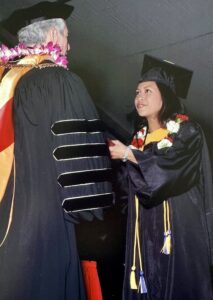
Abellera graduated from Santa Clara in 2004 with plans to attend medical school. Photo courtesy Abellera.
“And I thought, I’m never going to go nuts for that [research] stuff. … I’m going nuts for doing this play for absolutely no money in some podunk black box theater in the Tenderloin,” she remembers. Ultimately she realized, acting “is what I need to be doing–this is where I’m going to thrive, and this is what I’m going to be good at.”
Passion was the missing link. “I would’ve been a fine doctor,” Abellera says. “But when I want to do something right, I want to be so sure of it and so passionate about it.” So instead of med school, she got her master of fine arts in acting at University of Southern California.
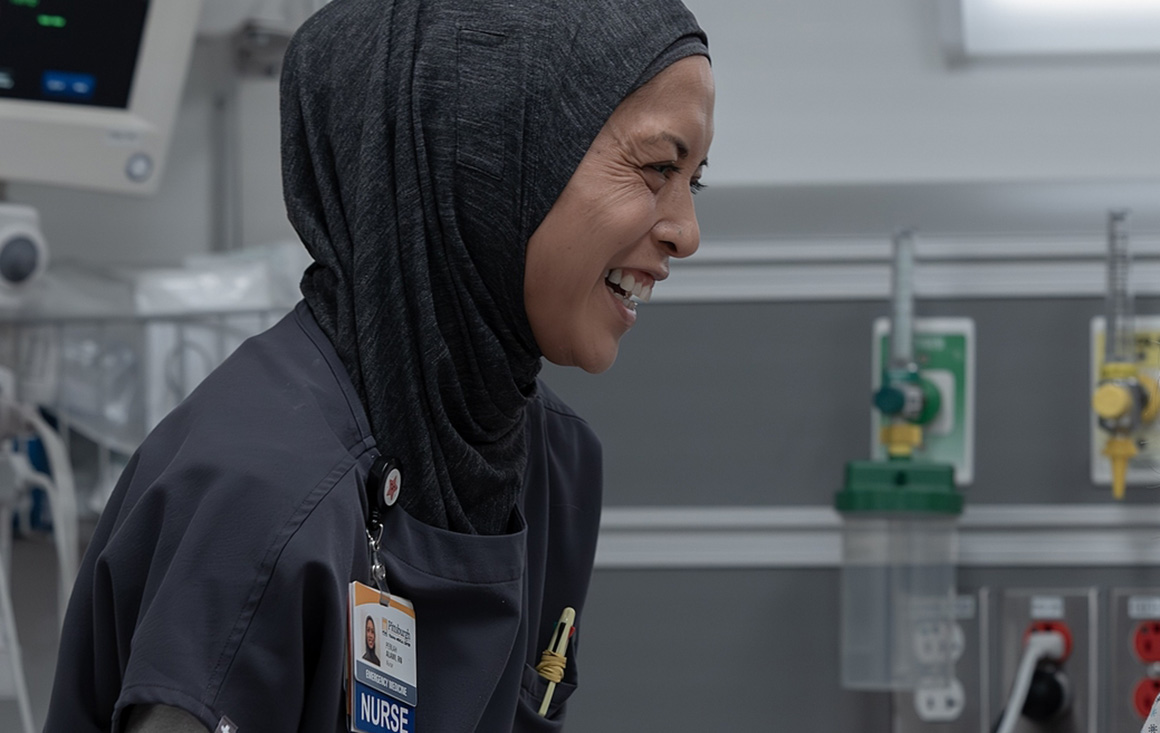
Today, she’s enjoying getting a taste of what might’ve been by putting on scrubs every day, memorizing dialogue full of complex medical jargon, and acting as a nurse in medically accurate ER procedures and surgeries—“The Pitt” has board-certified emergency physicians and former healthcare workers on its writing and advisory staffs. The show is resonating so much with viewers, she thinks, because it highlights people who are passionate about their jobs. And who are just really, really good at them.
“I can relate to that, watching the show or anything where someone is an expert at what they do and they’re passionate about it,” Abellera says. “I love the competency aspect of it, but I also love how it shows that these experts are humans with flaws and also need care.”
She’s also pleased by the show’s diversity. For one, it portrays the rich history of Filipino nurses in the United States. Perlah is a Filipina Muslim who wears a hijab and gossips in Tagalog with her bestie and fellow Filipina nurse, Princess (played by Kristin Villanueva). Abellera is not fluent in Tagalog but grew up more or less understanding it and says she can deliver lines in a passable accent. Before filming started, she researched a backstory for Perlah by speaking with Muslim nurses about their experiences in hospitals.

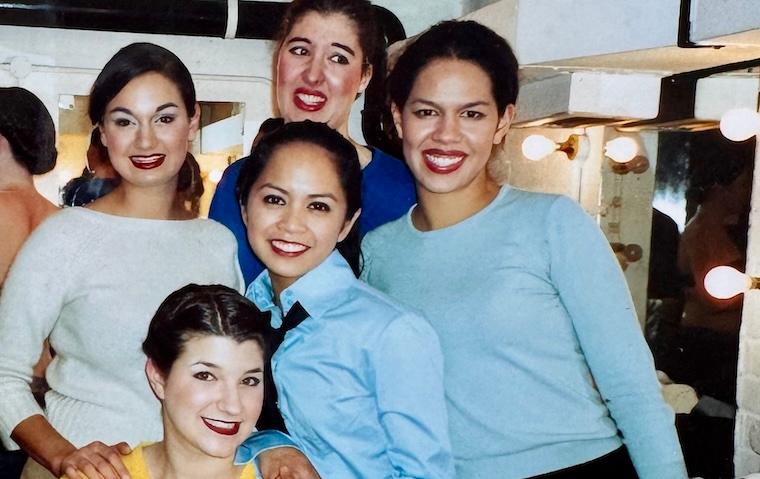
Abellera (third from left, top row) participated in Barkada multicultural club, which promotes awareness of Filipino culture on campus.
There weren’t a lot of people that looked like Abellera on the big or small screen when she was growing up, but “there does seem to be a shift recently of Filipino and Filipino American stories making their way into artistic spaces like art and sports and cuisine and television and film, literature,” she says. Last year, Abellera voiced one of the characters in the DreamWorks animated film “Forgotten Island,” which premieres September 25 and features Filipino folklore. She’s so glad her six-year-old daughter with partner Anastasia Coon is growing up in this media landscape.
Because, who knows, perhaps if Abellera had encountered more examples of diversity in the pop culture she so hungrily consumed as a kid, she wouldn’t have denied herself from pursuing her true passions. There’s an expectation she’s had to learn to forget that you choose a path in life and it’s a straight path and it’s “going to lead to the next step and that’s going to lead to the next step and all of those steps have to be correct,” she says. But life isn’t like that. Straight paths leave very little room for mistakes and learning and joy.
If she could go back to her time at Santa Clara, she’d tell herself “to be open to those moments that I learn something new about myself.” Of course, you can’t go back, she says emphatically, knowingly. All she can do is encourage the people coming up behind her to “allow the path to be messier.” You’ll be so much happier in the end.