Santa Clara University opened in 1851 to serve the influx of people moving to California seeking a better life and new opportunities. Today, the University still serves students chasing big dreams—and it brings together leaders across business, government, nonprofits, and academia to tackle the world’s most pressing challenges near and far.
Earlier this month, Silicon Valley-based think tank Joint Venture released the results of its latest poll. The central question: Is the dream of a better life in Silicon Valley still possible?
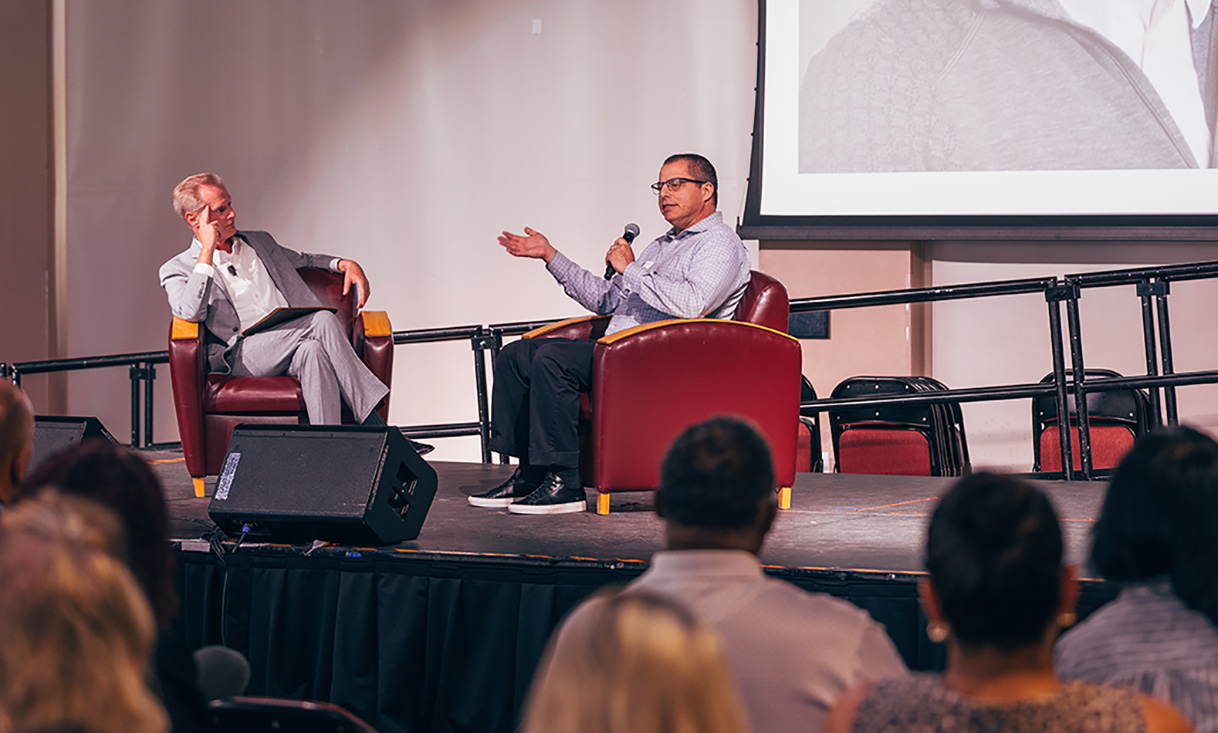
“Hard work has always been the formula here, right? Work hard enough, you can pursue that path to success and creativity. This year, only 45% of respondents agreed with that,” explained Joint Venture CEO Russell Hancock, who led a debrief discussion about the poll in Santa Clara’s Locatelli Center—a fitting host as a founding member of Joint Venture’s Institute for Regional Studies.
The event brought together cross-sector leaders from business, government, nonprofits, and academia, along with community members and Joint Venture board members to put context to the numbers and hopefully find a few possible solutions.
Speakers included representatives from Stanford University, Kaiser Permanente, the Public Policy Institute of California, and two Santa Clara University experts: Professor John Ifcher, an economist who studies happiness and inequality; and Irina Raicu, who directs the Internet Ethics program at Santa Clara’s Markkula Center for Applied Ethics.
“That rich data that Joint Venture brings gives us a really comprehensive picture of the patient in this situation—and the patient here is our community,” said Dr. Rakesh Chaudhry of Kaiser Permanente. “It’s a challenge to figure out how healthy the community is, what ails the community, and what we can do to help.”
Meeting the moment
When asked to name the region’s biggest problem, 95% of respondents overwhelmingly said housing and cost of living, a result Hancock noted has not budged in the six years of running this poll and is certainly not an issue that’s isolated to the Bay Area; however, the scale speaks to the urgency.
“You never see this in survey research. You never see this in elections. George Washington did not get 95% of the vote. This is a stunning result,” he said.
Another major trend discussed was a deepening distrust of tech industries and AI technology, citing ethical, environmental, and economic concerns that feed into existing wealth and power gaps in the region.
“People don’t like inequity in either direction. They don’t like advantageous nor disadvantageous inequity,” said Ifcher. “We’re definitely in a period of disruption because of AI and so many changes all happening simultaneously.”
With the region’s biggest pain points clear, speakers also highlighted what was going right in the region.
On AI, poll respondents said they trust neither tech companies nor the federal government to develop or regulate it responsibly. However, Raicu noted hope on the horizon: California and other states are passing new AI laws, allowing state and local governments to step up. Public pressure is already working, she added: this year, outcry over data centers led to new laws requiring transparency on their energy and water use.
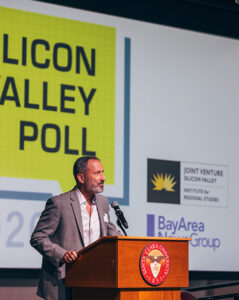
Provost Glaser offering opening remarks.
At a time when tech billionaires like Marc Andreessen or Mark Zuckerberg dominate headlines, Raicu believes that the region’s success will ultimately come from everyday people.
“The fact that people think the voice of Silicon Valley is a couple of CEOs drives me nuts,” she added. “Everybody in this room is Silicon Valley, right? And the voice of Silicon Valley is raising important concerns.”
Santa Clara’s provost, James Glaser, also shared the University’s own “big swings” to mitigate the region’s affordability squeeze, shortage of healthcare providers, and distrust of AI. Among them, he cited an upcoming capital campaign to meet the full demonstrated need of every undergraduate; the establishment of the Mark & Mary Stevens School of Medicine, a collaboration with Sutter Health; and the launch of the Cunningham Shoquist Center for Applied AI and Human Potential.
And in a room filled with diverse leaders across healthcare, education, tech, policy, and beyond, the event itself was its own small step towards a solution: gathering people with a common purpose to learn from each other in the name of the greater good.
“Universities aren’t competitors,” Glaser said. “We are partners and friends and collaborators taking on a set of common issues, and we need each other to thrive.”