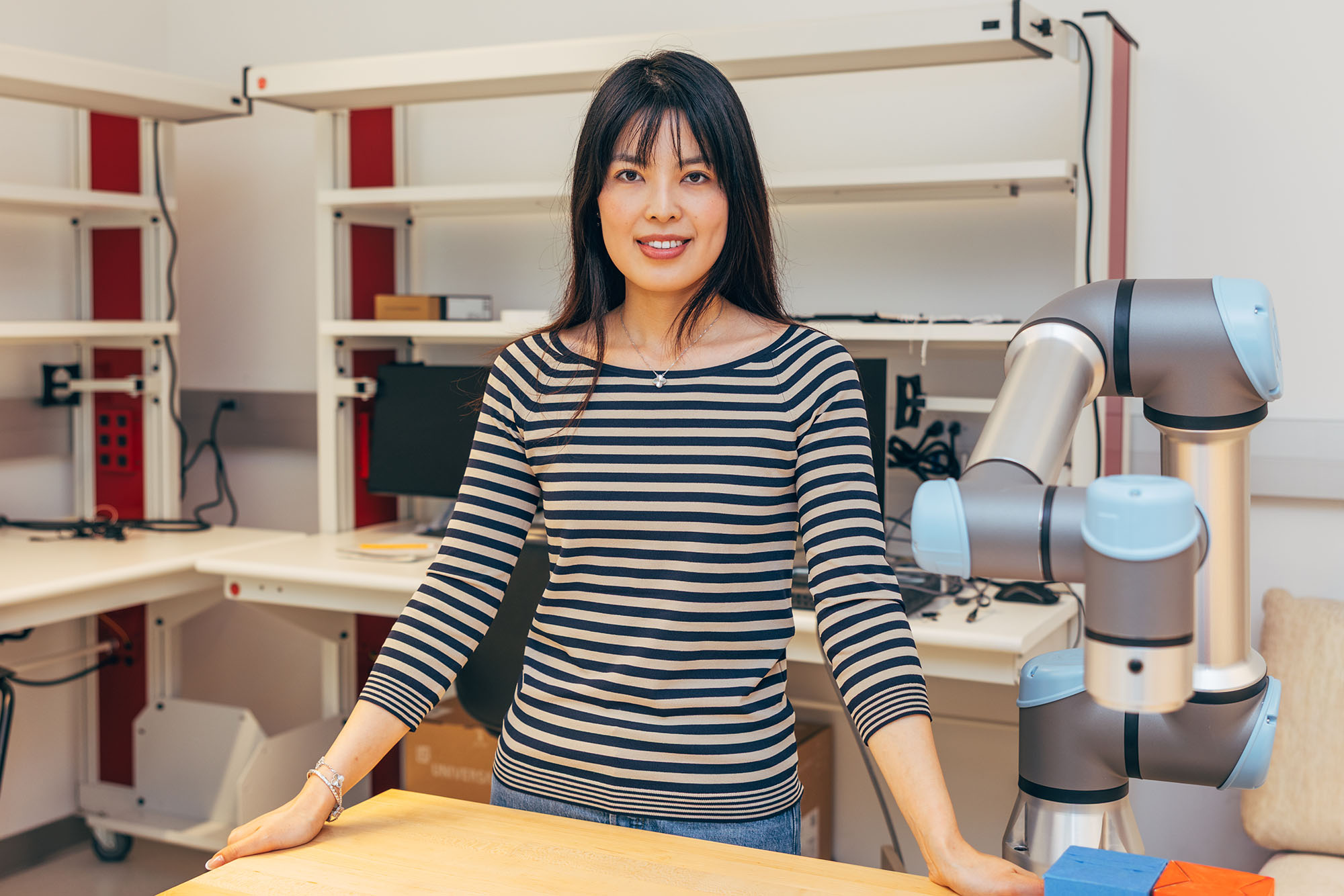
Hannah ‘Xiaoou’ Yang is an assistant professor of mechanical engineering at Santa Clara University. She researches advanced manufacturing and system design, with a focus on human-AI interaction in manufacturing settings. For Yang, an important question is how evolving technologies can support and serve factory workers while respecting their human expertise. As AI becomes more prevalent in the workplace, she believes finding a solution to improve the collaboration between humans and technology is essential.
What questions or challenges are at the heart of your current work?
My research is about building a future where humans and artificial intelligence systems work together to achieve more than either could alone. Manufacturing has become increasingly intelligent. We now have AI that can interpret complex information and robots that can do the physical tasks we once relied on humans to do. However, technological capability doesn’t guarantee that humans are supported in their work.
I’m particularly interested in how humans, AI, and robots communicate and make decisions together in manufacturing settings, like factories and warehouses. Some of the questions at the heart of my work include: how can we design technologies to better assist the human workforce and improve manufacturing efficiency and quality? And in doing this, how do we protect workers and their well-being? I also explore what should be under AI control versus human control and how we can create systems that address potential uncertainties manufacturing workers may encounter on the job. The goal of my research is not to maximize automation, but rather to create better collaboration between humans, AI, and robotic systems.
Why have you chosen to dedicate your career to this research?
My background is in mechanical engineering, so I’ve always been interested in how we can make physical systems more intelligent. As I became more and more involved in automation and AI in graduate school, I realized there are so many problems that occur at the boundary between AI technologies and the people who are using them.
For example, think about a robot that operates perfectly in a lab environment but doesn’t perform as well in a real manufacturing environment. In the same way, an AI system may produce a technically correct recommendation, but present that recommendation in a way that doesn’t actually help people make effective decisions. That’s the gap that really interested me in pursuing this research.
Why is this issue important for the world to address at this time?
AI is moving from the digital world to the physical world very quickly, and we are observing that process. At the same time, the manufacturing industry is dealing with workforce shortages, increasingly customized product demands, supply chain uncertainty, and pressure to become more efficient and sustainable. AI and robotics can help tremendously, but we also have to think about how manufacturing systems are designed to better support humans—especially when AI comes into the picture.
We have the opportunity to shape how AI changes work rather than simply reacting to it afterwards. I don’t think success should be defined simply by asking, “Can we automate this task?” Instead, we should be asking: “Does this system make the work safer? Does it improve human well-being? Can humans actually understand when something goes wrong?” I think those decisions are being made right now. That’s why human-centered AI is very important.
How have your students impacted your research?
My students have had a significant impact on shaping my research because they don’t simply execute tasks that I assign them. They help guide the direction of the work themselves. One thing I especially enjoy about working with students at Santa Clara University is that they take ownership of the research and turn their ideas into very good physical systems. They’re passionate about getting hands-on experience so they can successfully build these systems themselves.
My students ask brilliant questions that researchers and designers often overlook. They learn to identify and solve problems, turning virtual systems into physical systems that perform better than existing ones and sometimes challenge my own assumptions. There’s a two-way relationship between me and my students. I guide their development as researchers and engineers, while their curiosity and perspectives shape my research direction.
How does focusing on human-AI interaction and intelligence manufacturing through a Jesuit lens change the way you approach your research?
As engineers, it can be very easy to just focus on the technical performance. For example, making the model more accurate, making the robot faster, or making the manufacturing system more efficient. Those things are very important, but they don’t tell us the whole story.
My research specifically focuses on human-centered intelligence manufacturing, which aligns with the University’s Jesuit value of serving others. I shift the question from “What can this technology do?” to “Who does this technology serve?” I consider the people who are directly affected by the technology: the manufacturing workers. Does it make their work safer? Does it respect their expertise? Does it give them meaningful control? Or are we improving productivity at the expense of human well-being?
The Jesuit focus is something I really value about doing my research at Santa Clara University. Technology should ultimately be designed to serve people, rather than asking people to adapt themselves to technology.
What is a book in your field that you think everyone should read?
I would definitely recommend The Design of Everyday Things by Don Norman. It’s not simply a robotics or AI book. It’s valuable because one of the fundamental ideas in the book teaches us that when people repeatedly struggle with technology, we shouldn’t immediately assume that the person is the problem. We should ask whether or not the technology was designed in a way that people can naturally understand.
Technology isn’t considered well-designed simply because it works. It’s well-designed when people can understand it, work efficiently with it, and remain meaningfully in control. The book teaches us a lesson that we need to understand as we think about the future of manufacturing. It goes beyond the development of AI technology. It’s also about how we design technology to work with humans and support their well-being.