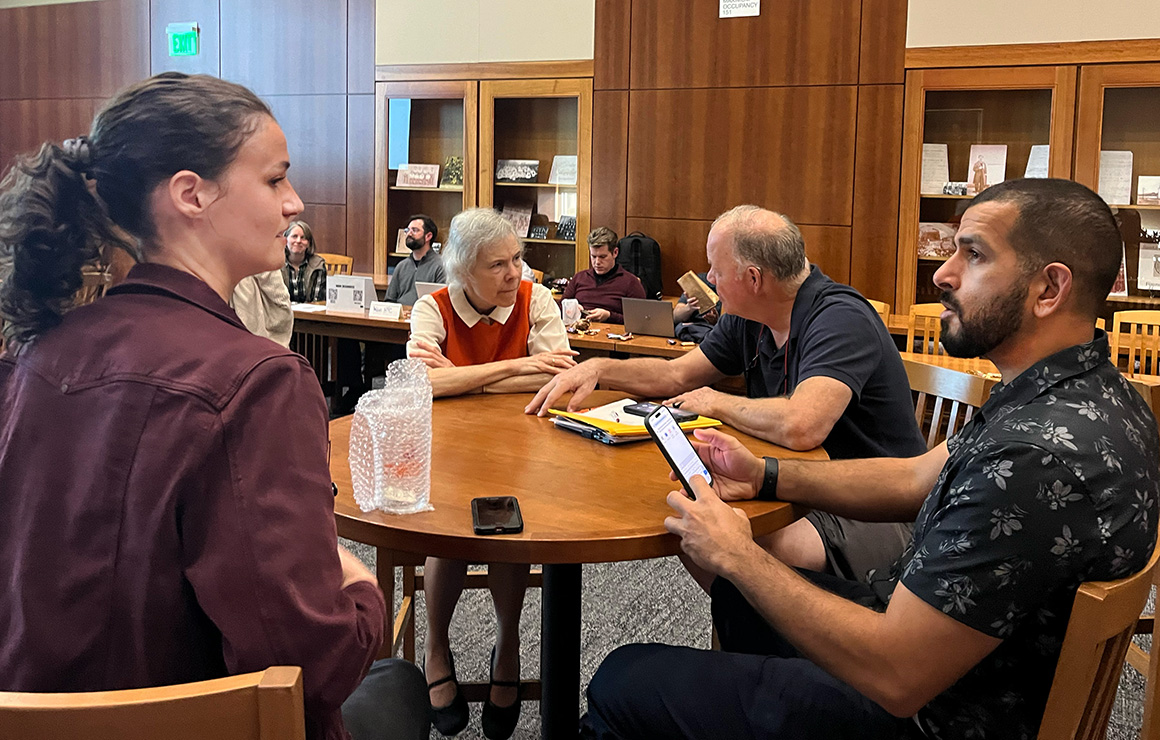
These days, Santa Clara’s faculty are doing more research than ever, said Provost James Glaser, sharing his sense of pride with a room of faculty and campus partners at the library’s third annual Research & Brew, where researchers each had five minutes to explain their work.
In the latest U.S. News & World Report national rankings, Santa Clara has risen into the top 15% of universities nationwide, alongside the likes of NYU, Boston College, and Purdue. The next time Santa Clara is evaluated, Glaser expects to see another bump thanks to a surge in research projects and grants over the last few years. For example, engineering research projects have doubled in the last year, and Santa Clara’s High-Performance Computing Center is working to triple the school’s research computing capacity.
“These days, creating knowledge is very important,” Glaser noted, adding that faculty research not only provides students with real-world skills—it also goes a long way to addressing what the world needs.
This crucial research was the star at Research & Brew, which featured five faculty in the midst of research:
Eric Goldman, from the School of Law, previewed his forthcoming book, which argues that the societal benefits of online conversation spaces are jeopardized by a push for greater Internet regulations. Law colleague Taylor Dalton traced how the language of international treaties has shifted from firm enforcement toward softer recommendations. Kirsten Read, from psychology, explained why preschoolers learn better from predictable patterns than surprising ones. Andrew Ishak, from communication, shared news of his film series on Coptic priests, with the second film premiering at a New York City film festival and screening at Santa Clara’s campus this month.
The catch? Each had only five minutes for their “lightning talk.” Packing a study, a project, or even a book into five minutes forces researchers to drop the jargon and make their work accessible to anyone—be it the engineer, the humanist, or the curious student in the audience.
“The biggest challenge is nuance,” says Paul Gilbert, an associate professor of public health. “Even from my study, what made it into my paper is still pretty dense, and then distilling that into a quick five-minute presentation is another story.”
He presented a recent paper about non-abstinent sobriety, receiving a laugh from the crowd at the irony of being at an event with beer. Though a tongue-in-cheek juxtaposition, it was perhaps a fitting one, as Gilbert’s research found that individuals who pursue independent recovery outside of 12-step and AA programs will change their sobriety goals based on age, health, context, and community. This better understanding of non-abstinent sobriety might offer practitioners more ways to support patient recovery—no matter which path they take, explained Gilbert.
In addition to the faculty presentations, librarians and campus partners presented on the behind-the-scenes support available to faculty and student researchers alike—covering topics from campus surveys and grant-finding tools to AI tool evaluation rubrics and high-end computing support.
“Research support is provided in all these different pockets across campus, and it’s not always clear to faculty members who can provide the support and where to go for it,” says Nicole Branch, dean of the University Library, who helped found Research & Brew after interviewing faculty about their research support needs as part of a national study. “The beer is just a bonus.”
With guests milling around the research support tables, catered Oktoberfest fare in hand, the hour of post-presentation conversations was where the proverbial lightning struck again.
Last year, Professor Maria Kyrarini in mechanical engineering shared her work designing robotic assistants for people with disabilities and industrial uses—a project that drew in neuroscience and humanities faculty for further conversation.
“That presentation led to some really interesting ethical questions,” Senior Director of Sponsored Projects Mary-Ellen Fortini recalls, “and to some really new partnerships that were not thought of before because the neuroscience department didn’t know what was going on in the mechanical engineering department.”
Gilbert, who attended last year, says that interdisciplinary, collegial exchange of ideas is the biggest boon of the event.
“I love hearing from other folks, even in wildly different fields where I don’t know anything about what they’re talking about,” he says. “I still find that really interesting—who’s doing what, and what’s going on.”