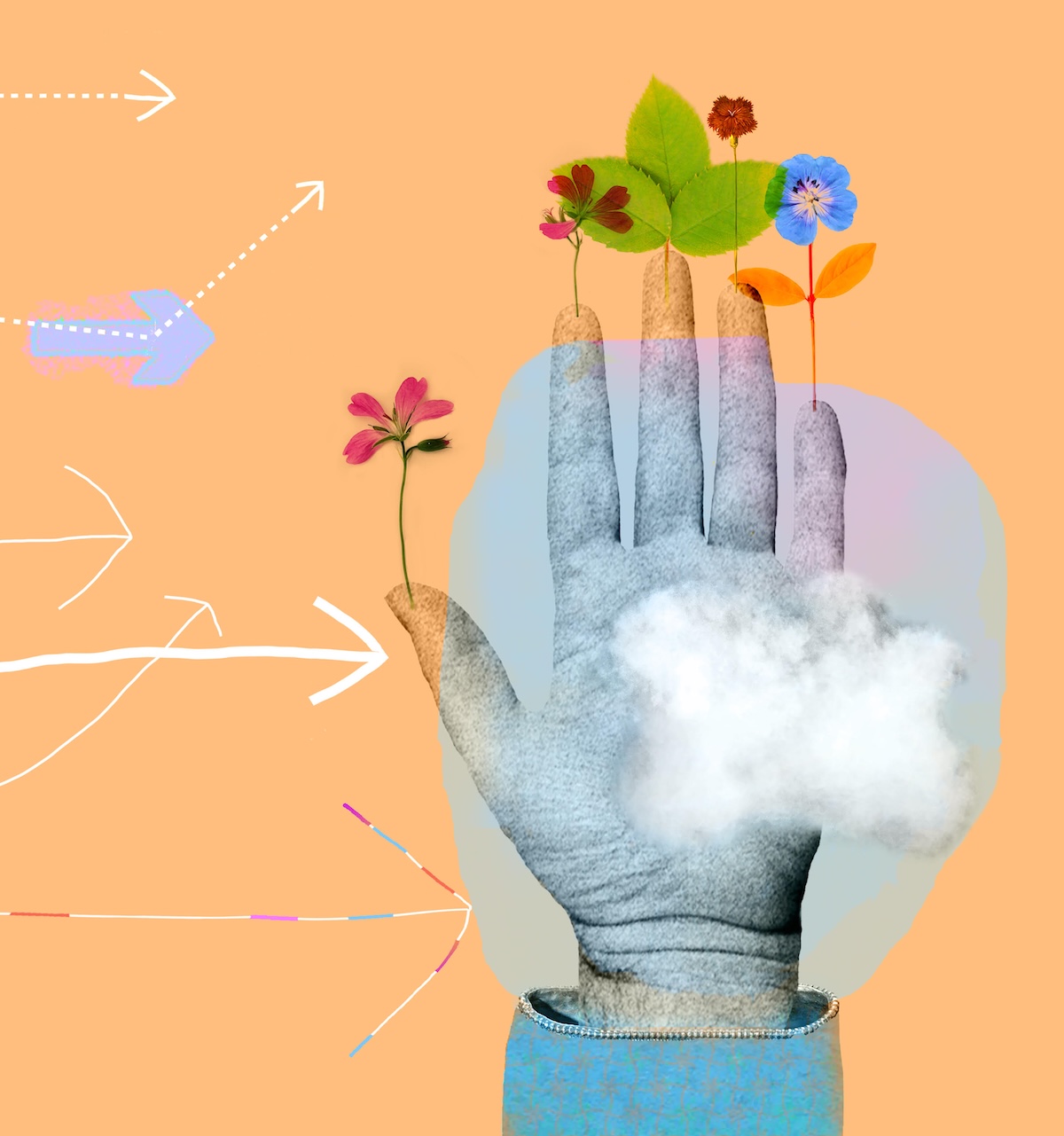
Illustration by Matthew Richardson.
It’s happened to all of us: the wave of overwhelming stress that descends in the face of starting a job search or watching another distressing news clip. You find yourself frozen, unable to start your task—or at a loss for how to help make anything better.
“Especially in these times, when so many of us are so stressed, anxious, and depressed, feeling overwhelmed by everything that’s coming at us on the news or on social media, it’s very hard to have a sense of agency and purpose,” says English Professor Emerita Diane Dreher, who holds a master’s degree in counseling. “If someone is really upset about current politics, then they, very often, don’t do anything. They get stuck in dysfunction, and that does not bode well for a participatory democracy.”
A potential solution for moving past that mental gridlock may lie at the intersection between mindfulness, or the awareness resulting from giving the present moment deliberate attention, and hope, or self-belief and motivation tied to working toward one’s goals. School of Education and Counseling Psychology professors David Feldman, a clinical health psychologist and hope expert, and Shauna Shapiro, a clinical psychologist and mindfulness researcher; Dreher; and 145 Santa Clara undergraduates explored each concept’s relation to depression, optimism, executive functioning, stress, and a variety of other markers over the course of a recent study.
The resulting paper, “Mindfulness and hope: distinct yet complementary relationships with psychological well-being,” published earlier this year in Scientific Reports, highlights that while present-moment mindfulness and future-facing hope may seem contradictory, they can work in tandem powerfully to support good mental health.
“Mindfulness helps us see clearly what is happening now. It teaches us to pause, stay present, and meet our experience with greater kindness. This can reduce reactivity and help us respond more wisely when life is difficult,” says Shapiro. “Hope helps us look ahead. It strengthens our ability to identify meaningful goals, imagine possible pathways toward them, and believe that our actions matter.”
Feldman, Shapiro, and Dreher administered surveys that asked students to evaluate how closely suggested statements matched their own experiences. The professors found that while factors such as disinhibition and anxiety reduction were associated with mindfulness, other factors, such as life satisfaction, were connected to hope. Optimism, self-compassion, and management of stress and depression were among the markers associated with both—but unexpectedly, mindfulness and hope themselves did not correlate in a significant way. These results suggest that mindfulness and hope play individual, independent roles in well-being, but complement each other in a way that can help build mental resilience. Awareness of the current moment can lay the groundwork for visualizing the future.
“Mindfulness and hope work together beautifully to help people find a sense of personal balance, inner peace, and then move forward to create new possibilities,” says Dreher.
“In therapy, these approaches could work beautifully together. We sometimes describe this as ‘mindful hope,’” Shapiro adds. “Mindfulness does not mean giving up on change. Hope does not mean denying reality. When brought together, mindfulness helps us see clearly where we are, and hope helps us take the next step toward where we want to go. Both can be practiced. Both can grow stronger. We do not have to choose between accepting the present and working toward a better future.”