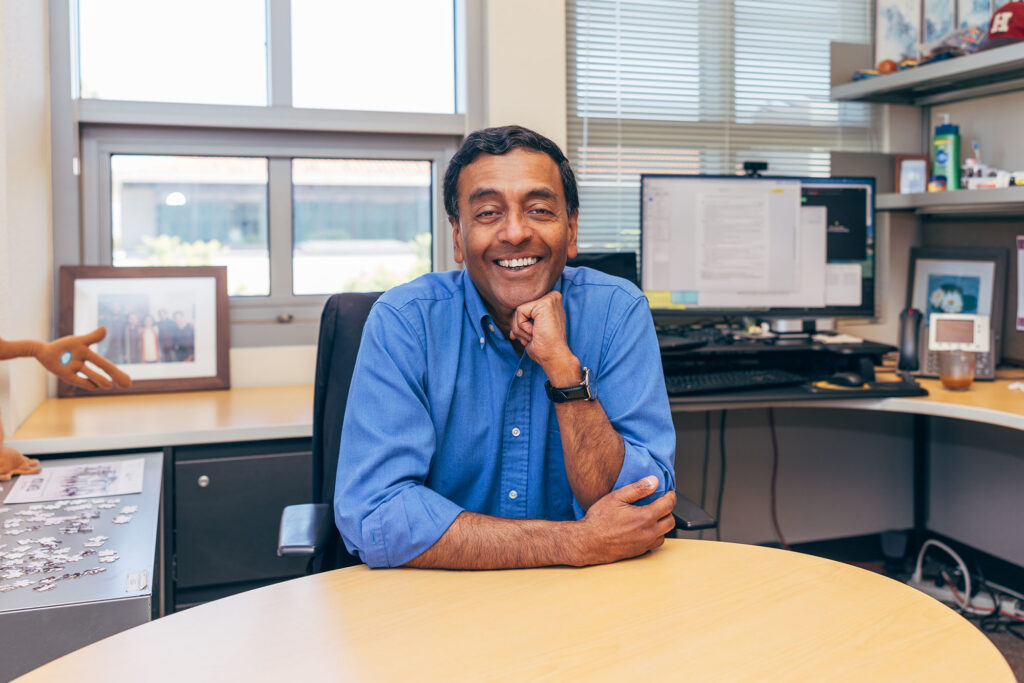
Xiaosheng Huang is a professor in the Department of Physics and Engineering Physics at Santa Clara University. He uses artificial intelligence to investigate dark matter, dark energy, and the expansion of the universe. Through his research, Huang seeks to connect our understanding of the universe with the spiritual, intellectual, and emotional dimensions of the human experience.
What questions or challenges are at the heart of your current work?
At the heart of my work is trying to understand two of the biggest mysteries in astrophysics and cosmology: what is dark matter and what is dark energy? Ordinary matter, the material that makes up the stars, the planets, and you and me, accounts for only about 5% of the universe. Dark matter makes up about 25%, while dark energy accounts for the remaining 70%. We know these components are there, but we still don’t know exactly what they are or how they work.
One of the key questions I explore in my work is how to take advantage of AI and its capabilities while conducting research in a responsible and transparent way. Science depends on a certain level of trust from society, and as scientists, we have to be careful not to erode that trust.
Why have you chosen to dedicate your career to this research?
When I was in middle school, I came across the book “Relativity: The Special and the General Theory” by Albert Einstein. It talks about how spacetime is not what we think it is. At first, it all sounded like science fiction to me, and yet underneath it all, the math behind the theory is rock solid and simple enough that I could understand it, even at that age.
I learned that time can dilate and space can contract. It blew my mind that something that fantastical could actually be true. I wanted to learn more. The fact that I can be more than just an admirer of Einstein’s theory, but actually work with data to test and understand the theory further, is just a dream come true.
How have your students impacted your research?
My students have tremendously impacted my research. The thing that leaves the deepest impression on me is how bold they are. I have worked on projects with students where I wanted to be cautious, while many of them were much more adventurous than I was. They were willing to take initiative, pick up the pace, and explore ideas that I might have approached more conservatively. This tenacity has been very beneficial to my research.
How is AI changing the way students learn and conduct research?
With the help of machine learning and AI, students can start from a much higher platform and go into frontier research much faster. But with all its benefits come some challenges.
There are times when generative AI says things or uses terms that students are not familiar with. When this happens, students need to go back to the basics and plug those holes in their knowledge. The results produced by AI can also be very slick. You can almost get lulled into a sense that everything looks fine simply because the results read so well. However, that isn’t always the case.
Students need to be extra vigilant when working with AI. It is an ongoing learning process. As a mentor, I try to help students be in a position to maximally take advantage of AI but also maintain their identities as human researchers.
What is a book in your field that you think everyone should read?
I’ve easily read half a dozen biographies of Albert Einstein, but “Einstein: His Life and Universe” by Walter Isaacson is the best. He tells the story of the man—not just the scientist, but Albert Einstein, the human being, struggles and all. Isaacson also got the physics right, which is pretty incredible.
In a strange kind of way, it’s encouraging to see that even Einstein struggled. It made me realize that maybe there’s hope for me, too. The next time I feel like I’m struggling, I won’t get discouraged. Reading this book reminded me that even the greatest minds had challenges, and that struggling doesn’t mean that you can’t accomplish amazing things.