In recognition of National First-Generation College Celebration Week, Santa Clara University is celebrating the experiences of first-gen students, staff, and faculty. The following profiles offer a glimpse into the accomplishments of this community and how they continue to succeed and create opportunities for others.
Finding her way and advocating for others
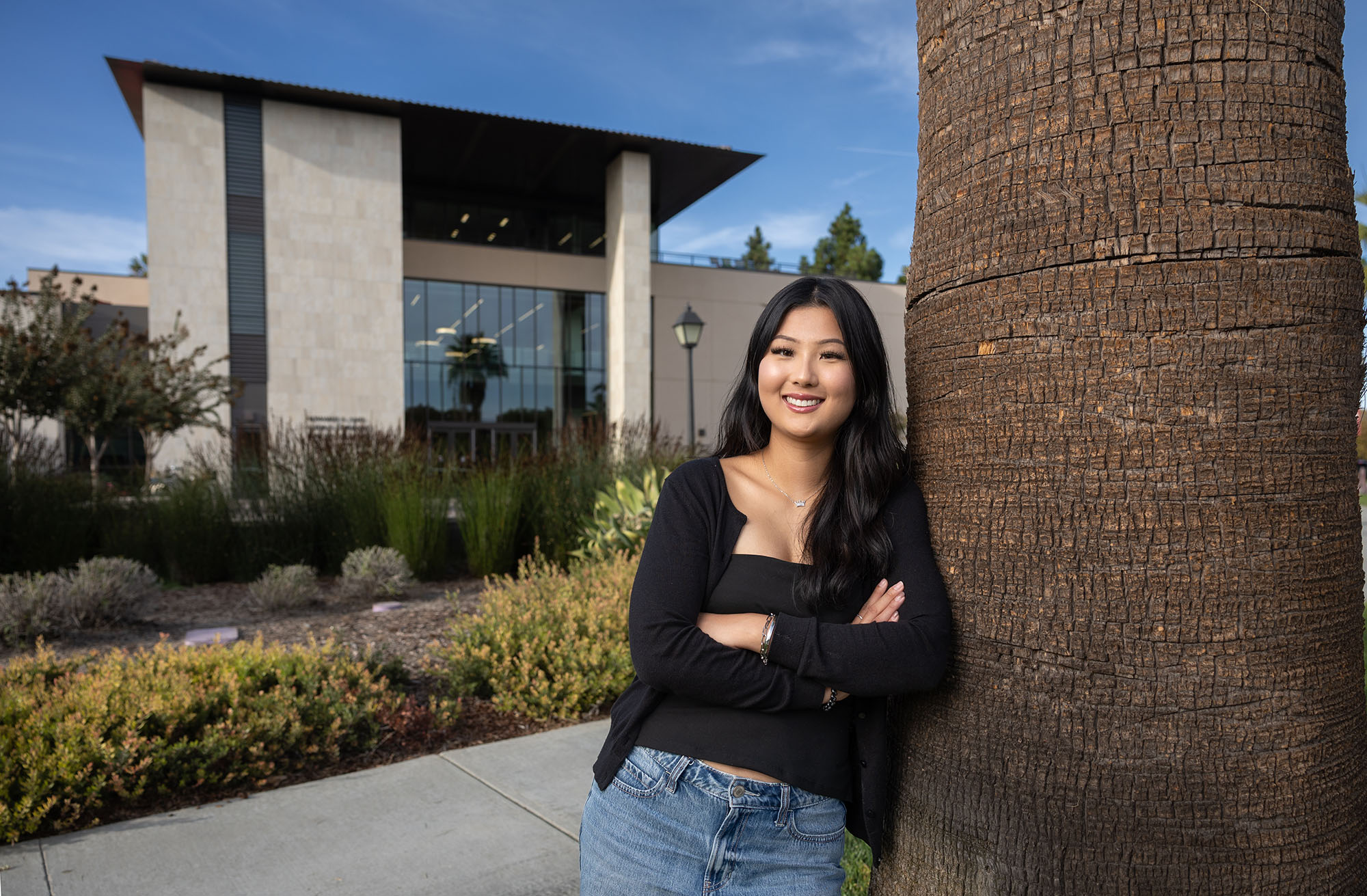
For Gayoung Couoh Lee ’27, helping others feel seen and supported is deeply personal. That commitment is rooted in her experiences growing up across countries and cultures, which ultimately inspired her passion for a career in public policy and law.
Born in South Korea, Couoh Lee moved with her family to Mexico, where she spent much of her early childhood before settling in the Bay Area. She adapted to new environments quickly, learning Spanish, English, and Korean all before the age of eight. In her multilingual household, Couoh Lee also took on the responsibility of helping her family navigate unfamiliar systems and understand everything from legal documents to doctors’ notes.
“I had to grow up really fast because I was the mediator and translator for my family,” Couoh Lee explains. “I understand what it’s like to feel vulnerable and how difficult it can be to access resources if you don’t know where to look. I want to be the person to amplify voices and create systems that are more equitable.”
Those experiences inspired her to study political science at Santa Clara, where she is pursuing a pre-law emphasis. Through the LEAD Scholars Program, Couoh Lee was able to quickly find personal and academic support when she transferred to Santa Clara. After talking to program staff, she learned about summer internship opportunities and secured a position at SV@Home, a non-profit organization that advocates for affordable housing in Silicon Valley through public policy and equity work.
As a housing justice intern, Couoh Lee researched affordable housing preservation models. For her capstone project, she interviewed San Francisco-based community organizations and explored how similar approaches could help with Santa Clara County’s anti-displacement efforts.
On campus, Couoh Lee also serves as a LEAD Seminar peer educator. After graduation, she hopes to gain experience in public policy and law before attending law school.
“Throughout my entire college journey, I took care of my family,” Couoh Lee says. “Now, I’m excited to live the life I’ve always dreamed of and pursue my passions in the legal field.”
Inspired by entrepreneurship, driven to help others
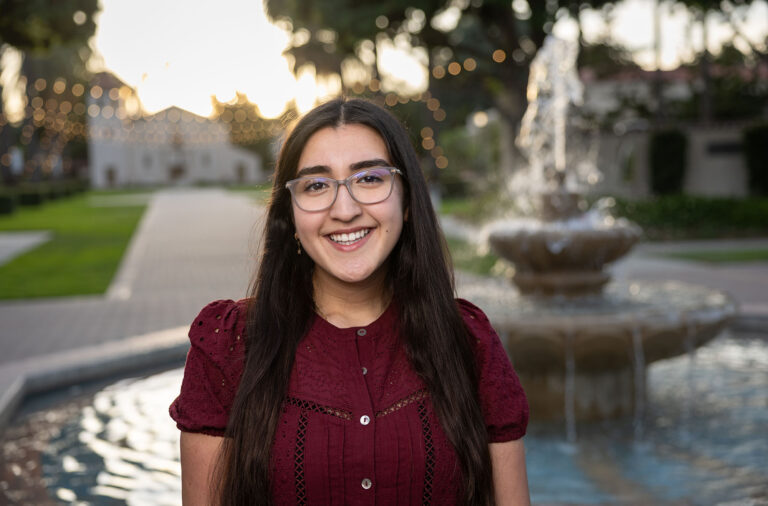
Photo by Jim Gensheimer
Watching her mom and aunt build a floral company from the ground up showed Estephanya Gonzalez ’29 the hard work and determination it takes to run a business.
“Seeing their dedication inspired me to pursue a career as a consultant and help other small, family-owned businesses turn their dreams into reality,” says Gonzalez, a communications and business management student. “I love Santa Clara because it has given me the opportunity to pursue something that really aligns with what I care about.”
As an operations and communications intern at Santa Clara’s My Own Business Institute (MOBI), Gonzalez is already putting that interest into practice. MOBI offers free online entrepreneurship courses to people around the world. In her role, Gonzalez translates curriculum from English into Spanish and helps develop stories about the program’s work.
“It helps me take what I learn in the classroom and put it into action,” Gonzalez says. “Through MOBI, I was able to attend the Latino Leadership Summit and learn from Silicon Valley business leaders about their entrepreneurial journeys and the importance of finding your shared community.”
Gonzalez has found support through Santa Clara’s LEAD Scholars Program, where a professor introduced her to the concept of navigational capital, the skills students develop as they find their way through unfamiliar situations and systems.
“I learned that my ability to advocate for myself and be resourceful and resilient are unique strengths I have as a first-gen student,” says Gonzalez, who became a LEAD peer educator to help fellow students make the most of the resources available to them.
“For me, being first-gen not only means being the first in my family to attend college but also encouraging those coming up behind me that they can do it too. It’s important for me to be an example of the opportunity.”
A full-circle journey
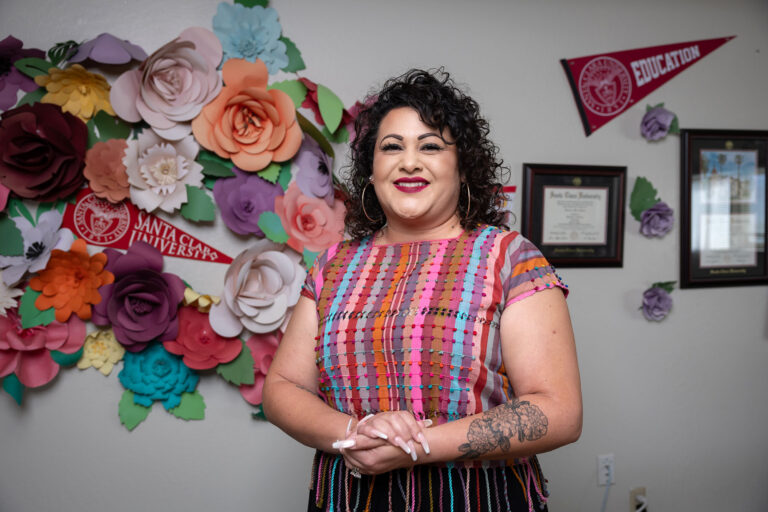
Photo by Jim Gensheimer
Reflecting on her own experience as a student at Santa Clara University, Verónica Villa ’10, M.A ’14 knows firsthand how meaningful support can transform the college experience. Her office in Alameda Hall evokes that same sense of care and belonging.
Colorful framed artwork, photographs of graduates, handwritten thank-you notes, and messages like protect your neighbor’s heart and la cultura cura fill the walls, creating a space that feels less like an office and more like a retreat where students can see themselves reflected and celebrated.
“I see myself in my students. Being there in hard times, celebrating good ones, and seeing them accomplish their dreams is one of the reasons why I love what I do,” says Villa.
A first-generation Chicana, Villa knew Santa Clara was where she wanted to attend college, but making that dream financially possible required some creativity. After her parents helped her cover her first year living on campus, Villa became a community facilitator and later an assistant resident director in the Unity Residential Learning Community, helping offset the cost of tuition while simultaneously becoming more involved on campus.
Villa studied psychology and Spanish, with minors in ethnic studies and urban education, and found community through the Bridge Program, which has since evolved into LEAD. She also co-founded Sigma Omega Nu, a Latina-interest sorority that still operates at Santa Clara.
Today, as associate director of curricular and co-curricular engagement at LEAD, Villa oversees the program’s academic seminars and connects students with career exploration and professional development opportunities. She also helps coordinate the Koret Fellowship Program, which provides financial support for students pursuing unpaid internships, research, and other professional opportunities.
Villa finds fulfillment in mentoring students and helping them navigate higher education. She hopes that they, too, will find careers that align with their passions.
“My hope is that no one person or situation can dim the light within them. I want my students to always pursue joy in whatever they do,” Villa says.
Villa is pursuing an Ed.D. in Social Justice Leadership at Santa Clara. Her dissertation, Sin Permiso, examines how Chicana higher education practitioners’ identities inform their work and the ways they advocate for students and challenge institutional barriers.
Bringing cultural expression into student-faculty research
At first glance, the tailored swagger of a zoot suit and the glossy, candy-painted finish of a hydraulic lowrider may look like they share little in common. Jacob Gutierrez Jimenez ’29, however, sees a deeper connection rooted in a tradition of cultural pride and resistance.
Gutierrez Jimenez began exploring that connection during his first year at Santa Clara University, where he examined the similarities between Pachuquismo—the Mexican American counterculture movement known for zoot suit fashion and political resistance in the 1930s and ’40s—and modern-day lowrider car culture in an advocacy research paper for his critical thinking and writing course.
For a mechanical engineering major, the topic wasn’t part of the coursework for his major, but important all the same. Both movements demonstrate how art can serve as a powerful expression of cultural identity and self-advocacy, especially for communities whose identities have historically been marginalized.
In the paper, Gutierrez Jimenez examines how Mexican Americans wearing elaborate zoot suits were vilified during World War II, when strict restrictions on fabric usage by civilians fueled criticism toward their clothing and community. He connects the fashion to lowrider culture, where hydraulic engineering and vibrant paint jobs transform cars into bold expressions of cultural identity.
“In my culture, Pachuquismo and lowriders have allowed people to represent who they are defiantly, regardless of the spaces they are in,” Gutierrez Jimenez explains.
With encouragement from Verónica Villa, the associate director of curricular and co-curricular engagement for the LEAD Scholars Program, and his writing instructor, assistant teaching professor of English Caleb González, Gutierrez Jimenez began thinking about ways to extend his research beyond the classroom.
“I really sought to learn from Jacob and figure out how I could best support him through the process of actualizing his research on the page,” says González, who continued working with Gutierrez Jimenez to refine his research even after the quarter ended. “For my students, writing and language are assets, but it requires me as a faculty member to create welcoming spaces for expression because those spaces are not going to create themselves.”
Together, González and Gutierrez Jimenez developed an abstract and conference proposal, and began pitching their work to national conferences, most recently the National Association for Chicana and Chicano Studies conference. The project has also received funding through Santa Clara’s Office of Research for its continued development.
“I’m extremely grateful to have a mentor like Professor González because he is supportive and open-minded. He understands why it’s important for me to incorporate my culture into my research,” Gutierrez Jimenez says. “Ultimately, I want to incorporate abstract ideas and cultural perspectives into mechanical engineering problem-solving so that every voice is heard and no one is disregarded.