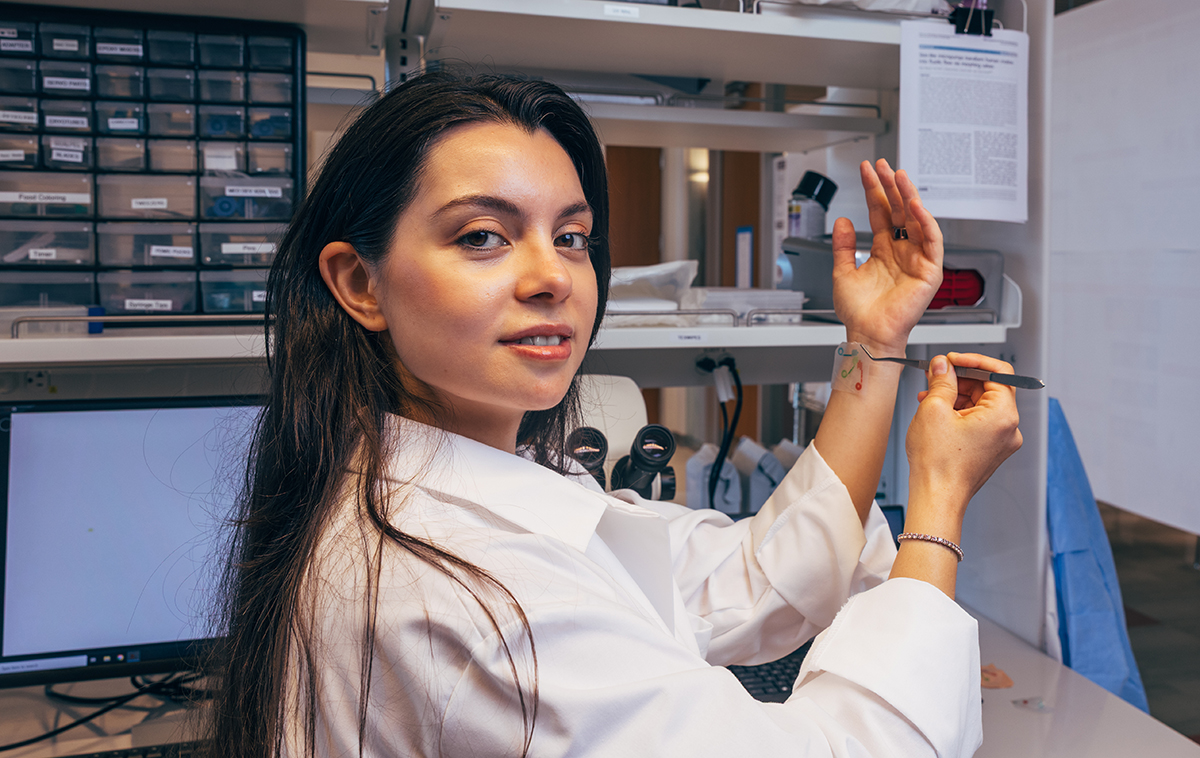
At its most basic level, OSMiPump works like other pumps, which create pressure imbalances to draw and push fluids. When OSMiPump’s flexible material is stretched, it pulls the fluid from a reservoir and then, when the material returns to its neutral configuration, pushes the fluid through one-way valves toward the administration site. The valves prevent backflow to keep the fluids moving in the desired direction.
But unlike traditional pumps, OSMiPump relies less on pressure and more on controlling the direction of the flow. In this regard, the valves are critical to OSMiPump’s performance. They keep fluids moving in the right direction. Testing several variations of valve arrangements, the team found that a series of smaller valves is superior to a single larger valve. The pump can be adapted to flow in either direction. Altay says that someday she can imagine bi-directional OSMiPumps that extract fluids for sampling and then deliver other fluids (medications) in response.
Altay describes potential uses including diabetes care where an OSMiPump-based device could sample fluids in the feet, where chronic wounds often lead to amputation, and then deliver drug treatments. She can also foresee wearable pumps that sample glucose in the blood and carefully mete out insulin as needed to keep blood sugar at optimal levels. Other potential wearables might sample blood or sweat during physical activity and deliver medications or nutritional supplements based on the body’s instantaneous biochemistry.
“Whenever you create skin strain—it can be walking, it can be bending a shoulder or elbow—the pump is activated,” she says. “Conversely, the pumping action can be reduced or completely stopped through positioning, since certain body positions minimize the skin deformation that drives the device. This allows the user to naturally activate or deactivate pumping through movement.”
Getting personal
In her research, Altay has discovered that output control of the device varies from person to person and application location on the body. Some people and certain muscle groups naturally generate more strain than others, she says.
“It’s really a form of personalized medicine,” Altay says. “Not everyone generates the same skin strain, but we can map individual skin strain before we place the pumps to control the exact amount of pumping.”
Beyond fluid delivery and extraction, the researchers are also exploring OSMiPump as a platform for physical rehabilitation monitoring. Because the device output directly reflects skin strain and body movement, it can serve as a passive indicator of motion quality, joint usage and rehabilitation progress.
“Physical rehabilitation is one of the first applications we are actively tackling,” Altay says. “The device not only responds to movement but also provides information about the magnitude and frequency of motion. That creates opportunities for tracking rehabilitation exercises, monitoring patient compliance and assessing recovery progress using a soft wearable system that requires no electronics or batteries.”
Overall, Altay and Araci are upbeat about the prospects for their clever pump. OSMiPump can be adapted to several forms, including being integrated in sock-like materials or as Band-Aid-like adhesive stickers that can be easily mounted on key points on the body. In one test, Altay mounted an OSMiPump sticker behind the knee. Another was mounted to the ankle.
“I think it could make a big difference, especially for wound care and drug delivery, where we are still dependent on the hard and rigid pump components,” Altay predicts. “These flexible, skin-like pumps would be much easier to apply and much more comfortable for the user.”