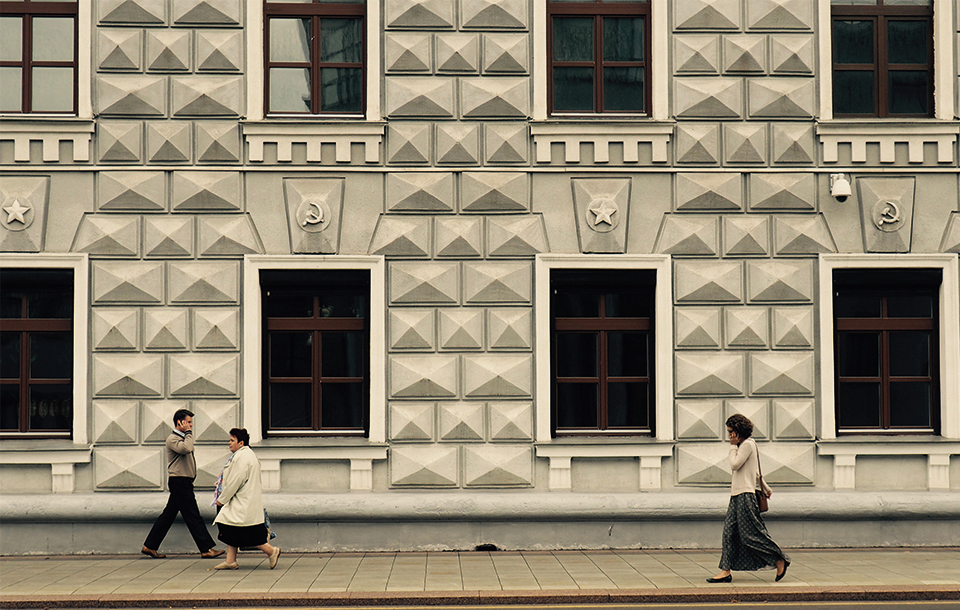
Ballot boxes. Two out of three are transparent.
Belarus kicked out the U.S. ambassador eight years ago and still doesn’t have one. But Belarus is not North Korea. And many people in Belarus are wary of Russian intentions; look what happened to Ukraine.
BAD MATH, BASEBALL, AND BERLIN
A week after the elections in Belarus, Russia held its parliamentary elections. In the September 18 vote, Putin’s United Russia party trounced all comers. Closed-circuit cameras caught commissioners stuffing ballot boxes in multiple precincts; those videos quickly popped up on YouTube. Where fraud was too blatant to ignore, the results were invalidated; a few days after the election, nine precincts had their results invalidated—including a couple where the number of ballots in the boxes exceeded the number given out to voters. Oops.
Along with the results of the voting, this election was important to Putin because of what would follow—or rather, what would not follow. There would be no repeat allowed of the 2012 protests on the heels of parliamentary elections, when tens of thousands of protestors took to the streets declaring “Putin is a thief!” In 2016, voter turnout was down significantly. But that’s not to deny that Putin enjoys support across huge swaths of the country— just as Lukashenka has real support in Belarus. Though you have to qualify that support as being accompanied by—and warped by—state-controlled media, and the fact that these are countries where dissidents and journalists are threatened, arrested, beaten, assassinated. The politics of posttruth gets along best with regime-friendly media.
Once more, Svetlana Alexievich offers some insight: “In the West, people demonize Putin. They do not understand that there is a collective Putin, consisting of some millions of people who do not want to be humiliated by the West. There is a little piece of Putin in everyone.”
As for me, I wasn’t in Russia for the elections. I was at the Giants game, enjoying the sunshine on San Francisco Bay while our boys in black and orange sleepwalked through a loss to the Cardinals. At the seventh-inning stretch, we sang “Take Me Out to the Ball Game” and then, as we have since the terrorist attacks in 2001, “God Bless America.”
That tune was composed by Irving Berlin, born in 1888 in the city of Mogilev, then part of the Russian empire, now in Belarus. He first penned “God Bless America” for a comical musical review during World War I—but the tone of the song didn’t fit. Two decades later, Berlin revised the lyrics for a radio broadcast by Kate Smith on Nov. 11, 1938—the first commemoration of Armistice Day. Twenty years after the Great War ended on the 11th hour of the 11th month, this holiday was meant to celebrate peace and an end to war. But fascism was ascendant in Europe; Czechoslovakia had already been betrayed in Munich, and Hitler had already seized the Sudetenland. In introducing the song, Smith said, “As I stand before the microphone and sing it with all my heart, I’ll be thinking of our veterans and I’ll be praying with every breath I draw that we shall never have another war.” The song began with a verse that is usually not sung these days—but words that bear remembering:
While the storm clouds gather far across the sea,
Let us swear allegiance to a land that’s free.
Let us all be grateful for a land so fair,
As we raise our voices in a solemn prayer:
For some across the sea, the clouds were not merely gathering; the storm had begun. The night before became known as Kristallnacht, the night of broken glass. Synagogues across Germany and Austria burned. Thousands of Jewish shops were destroyed, scores of people killed.
Irving Berlin tweaked the lyrics for “God Bless America” again when the sheet music was published in March 1939. A peace anthem no longer seemed right for the times. For a while, the song eclipsed “The Star-Spangled Banner” as the most popular patriotic song in the United States.There were repeated attempts to make it the national anthem. Both FDR and Republican Wendell Willkie used it as a campaign song in 1940. Berlin gave all royalties to the Boy Scouts and the Girl Scouts. But the Ku Klux Klan was no fan of this song—penned, as it was, by an immigrant Jew; what right did he have, they asked, to invoke God and call America his “home sweet home”? Perhaps the plan to make the song the national anthem was part of a grand Jewish conspiracy. One American pro-Nazi paper opined that this was not “a ‘patriotic’ song, in the sense of expressing the real American attitude toward his country” but instead “smacks of the ‘How glad I am’ attitude of the refugee horde.”
The KKK called for a boycott of the song. (Thankfully, in the 21st century, this kind of white supremacist nonsense has all been consigned to the dustbin of history, right?)
As for the Giants, after that Sunday defeat, their bats woke up—enough to win the wild card and give the Cubs a run for their money in the playoffs. Here I should offer by way of full disclosure that I was born and bred in Chicagoland, and the geography of my youth has shaped my attitudes toward both elections and baseball: the elder son of a rock-ribbed Republican who took his boy to his first game at Wrigley at age 5, who set me on a path to believe that there could be a measure of truth to the notion that rooting for the Cubs was like rooting for world peace. It might not ever happen, but you couldn’t stop believing.
PRAYERS FOR THE DEAD
The whirlwind of World War II hit hard on the land where Irving Berlin was born. A quarter of the population of Belarus—2.3 million people—perished. Belarus also earned a reputation as a land of fierce partisan fighting; the reprisals, in turn, were brutal.
Work on the Friday before the election in 2016 took us near the village of Khatyn—a memorial of cruelty and sorrow. In March 1943, after a partisan attack on German soldiers nearby, SS troops rounded up all 150 villagers— including women and children—in a barn and set it on fire. Soldiers machine-gunned anyone who tried to escape. Then they looted and burned the village to the ground. Khatyn lies in an idyllic glen, and in the fading September day, golden light through the trees cast lengthening shadows. There are no houses in Khatyn now. There are stone chimneys as symbols of that which did not burn; each bears a plaque inscribed with the names of the family members of a household, and each chimney holds a bell. Every 30 seconds, the bells chime—sharp, brusque, not quite in unison, a stuttering echo across the fields.
Khatyn is not alone in what it suffered. Hundreds of such villages in Belarus were destroyed. But to make a pilgrimage to Khatyn is to look into the dark recesses of our collective soul. We, as a species, are capable of this.A week after the election, Belarus was in the news again: backstory to an obituary of Shimon Peres, “one of the last surviving pillars of Israel’s founding generation,” as The New York Times obituary put it. He built his country’s military, then he tried to make peace. He was 93 years old.
The village of Wiszniew was part of Poland in 1923 when Szymon Perski was born there and when his father, a lumber merchant, emigrated with his family to Palestine. Then came war, the Holocaust, destruction of Jewish culture in the region.Then the rearranging of borders: Vishnyeva became part of the Belorussian S.S.R. By the time Shimon Peres returned for a visit in 1992, hoping to find the house where he was born, the Soviet Union had collapsed. The village was part of independent Belarus. Journalist Joanne Levine, traveling with Peres, recalled how he sang a Yiddish lullaby his mother used to sing, then went house to house, knocking on doors, asking if people remembered his family. The house had been burnt down; so had all others that might have sparked a memory. He found a shard of a broken tombstone that belonged to his great-grandfather. He placed a stone and he said a prayer for the dead.
The next year, Peres and Yitzhak Rabin signed the Oslo Peace Accords with Yasser Arafat. It was a hopeful time. The Cold War was over, and peace in the Middle East seemed within grasp. The threesome shared the Nobel Peace Prize. A year later, Rabin was assassinated.
HELL FREEZES OVER
And then it happened: the second of November, 2016. All Souls Day for Catholics. For baseball fans, the day hell froze over. A toss from Bryant to Rizzo for the third out and the Cubs won the World Series. Perhaps world peace was next?
Not right away. Instead, the next day, Steven Seagal was back in the news. Putin had made him a Russian citizen. The day after that, observers for the largest ever OSCE mission for a U.S. election arrived on our shores: nearly 300 short-term observers from member states, working under a couple dozen long-term observers from throughout Europe. (Russia offered to send its own contingent of observers—a political stunt, since Russia is an OSCE member.) The OSCE has sent a token force of observers to the U.S. since 2000. But in 2013, the Supreme Court struck down aspects of the Voting Rights Act. With heightened concerns about voter registration and electronic voting, the OSCE decided a serious contingent in 2016 was needed.
On the morning of Election Day in America, I headed to my son’s high school to vote. The Boy is 15; this time around, he wanted to come with me. And I wanted him to be engaged—to understand that the right to vote in a free and fair election is not something we can take for granted. Like a free press, it’s a cherished pillar of liberal democracy. (Of course, there were Macedonian teenagers who were engaged in the U.S. election as well: inventing clickbait red meat headlines and stories in a digital advertising ecology that rewarded such behavior. File that under corrosive.)
A question: What if the endgame of an election isn’t sustaining liberal democracy at all, complete with protection of minorities and freedom of expression—but instead transitioning to illiberal democracy? Or simply to an illiberal state? We don’t have to look as far as Putin’s Russia or Lukashenka’s Belarus. These days, just travel to Poland, where the nationalist-populist government has curtailed freedom of the press; or to Hungary, where Prime Minister Viktor Orbán takes inspiration from Russia, China, Turkey, and Singapore—because, he said, the economic crisis of 2008 showed liberal democracies couldn’t be competitive.
Things fall apart, Yeats wrote. The center cannot hold.
THE PRELIMINARY ASSESSMENT
You’ve seen numerous recaps of the U.S. election—but perhaps not what the OSCE had to say. From a nonpartisan, international organization that has an interest in process, not outcome, a few verbatims:
Recent legal changes and decisions on technical aspects of the electoral process were often motivated by partisan interests, adding undue obstacles for voters.
More than an estimated 35 million eligible voters were not registered for these elections, underscoring the need for continued efforts to enhance voter registration, particularly among marginalized communities.
Intolerant speech by one candidate about women, minorities, and people with disabilities was frequent.
Contrary to good practice, 15 states use Direct Recording Equipment machines that do not provide a voter-verified paper audit trail.
In 13 percent of observations, observers noted malfunctions with electronic voting equipment.
It helps, sometimes, to see yourself as others see you.
“CHEER UP!”
Momentous political events—from the fall of the Berlin Wall to Tiananmen Square to the murder of the Jesuits in El Salvador—mark 1989 as an epic moment in history. A decade after the Velvet Revolution of ’89, I was in Prague for a conference celebrating the anniversary. Margaret Thatcher, Helmut Kohl, George H.W. Bush, and Mikhail Gorbachev were Václav Havel’s guests of honor at Prague Castle. Along with discussions, concerts, and rallies, there was disenchantment in the air; Gorbachev spoke of increasing backlash he saw against globalization. In a Q&A, I asked: What do you say to the people here in Central and Eastern Europe who feel they were misled—that democracy and a free market haven’t delivered what was promised?
Thatcher chimed in first. “Cheer up!” she said. More followed—but not enough of the stuff that would stir the heart and restore those whose faith in democracy was flagging.
In Russia, these were Boris Yeltsin’s final days as leader. On New Year’s Eve 1999, he resigned and apologized for some things that hadn’t gone as he had hoped, and he handed over reins to his chosen successor, Vladimir Putin.
Another confession: a deep-seated fear that we will look upon 1989 as the beginning of an era that has come to a close—in terms of commitment to global norms and rights and institutions that have kept the world from being a much more frightening and brutal place.
In the months since the autumn elections, there have been protests near and far. In Russia, in March, tens of thousands protested in scores of cities—raising their voices against corruption. Arrests were made. In Belarus, in March, people took to the streets to resist a new law against “parasitism”: Anyone who hasn’t worked in six months can be fined $250. The law’s implementation was postponed, yet the outrage not assuaged. Four hundred people, including journalists, were arrested. On the eve of May Day, opposition figures were rounded up.
“We are not idiots,” said Belarus’ President Lukashenka in his annual address to the National Assembly. He accused EU leaders of pouring dirt on his country. “We see what is happening inside the EU itself.” He added, with crude swagger: “I want to tell all the European leaders: You really lack something between the legs … You will soon realize your mistakes and will regret having made them. Why are you so stubborn? Where’s your democracy and tolerance?”
Indeed. It turns out that democracy is a messy and inefficient and fragile thing. And certainly never something we finish trying to achieve—unless we give up on it.
STEVEN BOYD SAUM is the editor of this magazine. Part of this essay appeared on KQED FM as “Belarus, Baseball, and Berlin.”