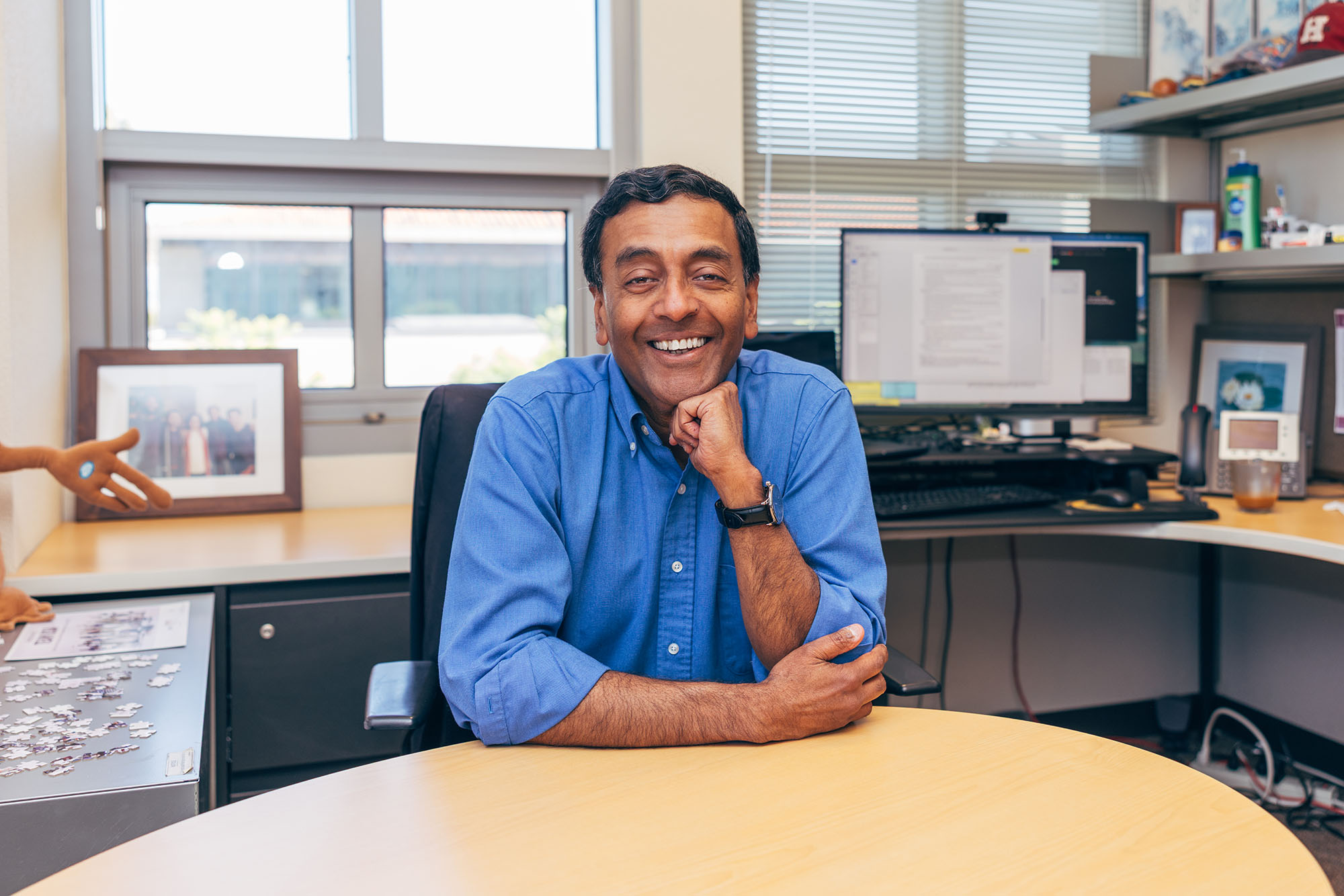
Sanjiv Das is the William and Janice Professor of Finance and Data Science at Santa Clara University’s Leavey School of Business, where he has taught and conducted research for the past 26 years. His research combines behavioral finance, artificial intelligence, machine learning, and mathematical modeling to help people make better financial decisions, particularly in retirement planning and wealth management. Das co-founded and co-directed the University’s M.S. in Business Analytics program. In addition to his professorship, he works as a research scientist with the Jupyter open-source team at Amazon Web Services (AWS).
What questions or challenges are at the heart of your current work?
I work in two different areas: wealth management and open-source software systems. I develop mathematical models that optimize retirement plans. More specifically, I develop algorithms for goals-based wealth management, an approach that helps people define their goals and optimize their dynamic portfolio strategy to achieve them over their lifetime. I started developing this strategy with Santa Clara mathematics professor Daniel Ostrov about a decade ago and it’s become very popular in the industry. Billions of dollars are now managed using this technology.
The way I explain it to people is that it’s like playing a video game where you’re driving a car and trying to collect as many rewards as possible. Your retirement portfolio is like that car. As you move through life, you’re trying to meet different goals whether it be paying for your children’s education, saving enough money for retirement, or making philanthropic donations. All of these goals sit on a timeline and our mathematical model helps people make optimal financial decisions that can help them achieve them.
The biggest challenge in retirement planning is figuring out how to actually explain it to people. Behavioral finance brings psychology into finance, which has traditionally been viewed as a very rational discipline. Another challenge is helping financial advisors understand how these mathematical models work so they can better explain their purpose to their clients.
As for my work with open-source software systems, I’ve always been fascinated with how they operate, how they create value for the economy, and how people organize themselves to build them. One project I’m actively involved in is called Jupyter. Jupyter is a programmable document interface containing text and code that has become very popular among scientists in reproducing results and telling the story of a research project. It’s a living document where you can write both plain and mathematical text, as well as code that can be executed to generate results. Scientists can enter ideas, test, code, and program them, all while keeping a record of their work. Jupyter forms the basis for reproducible research, where other scientists can repeat and verify the work in one place.
Both my current work streams give me tremendous satisfaction because they contribute positively to society. My work on wealth management is aimed at offering everyone with a retirement portfolio a better way of managing their finances towards achieving their life goals. My work in the open-source world around the Jupyter project helps improve a scientific tool used by thousands of scientists, available to everyone for free.
How has your research evolved over time?
I came to Santa Clara not working in behavioral finance at all. Two of my senior colleagues, Meir Statman, and Hersh Shefrin—both finance professors at Santa Clara—introduced me to the field. In learning from them, I realized that their work combining psychology and financial data had many follow-on applications in wealth management. I saw that as an opportunity to dive deeper into this specific work.
At that time, Statman invited me to join the advisory board of Bellatore, an asset management firm, alongside him and Harry Markowitz, the Nobel-Prize-winning economist known for his work on portfolio theory. Together, we explored the mathematical aspects of mental accounting, which is the way people tend to mentally divide their money into different categories. It led to a publication connecting behavioral portfolio theory to traditional portfolio optimization.
That led me to goals-based wealth management. The impetus actually came from a large asset management company in the Bay Area. They reached out to me because they wanted to develop an approach based on my research, but they didn’t have an algorithm for it yet. I began working with Ostrov to build one. Our research evolved as we discovered new problems and found ways to solve them.
We eventually got to a point where we published a working algorithm that fully solved the dynamic goals-based optimization problem, but we couldn’t scale it up. Now, advances in AI, particularly a technique called reinforcement learning, have allowed us to solve this problem at scale. This work has also been published.
Now, Ostrov and I teach a mathematical finance course together at Santa Clara where we share this work with students. We help them see how quantitative finance is implemented in the world and the benefits that come from applying math to financial problems.
How have your students impacted your research?
One of the great things about my department is that I am able to teach courses that are connected to my research. Students often ask questions that I haven’t thought about and challenge me to explain my work in a more accessible way. Graduate students bring real-world problems from their workplaces into the classroom. Sometimes, those problems inspire a research paper, and I’ll invite the student to work with me on it.
How does your work connect to Santa Clara University’s Jesuit mission?
At Santa Clara University, we tend to blend theory and practice as much as possible. This is part of the Jesuit tradition and is deeply ingrained in our culture. We’re also in Silicon Valley, so we can seamlessly work on industry problems. We use theoretical foundations and couple them with this applied work. Those connections carry into the classroom where students see the value of this blend of theory and practice, especially in our graduate programs where many students are currently working in industry and can appreciate that connection.
What is a book in your field that you think everyone should read?
I’d recommend A Wealth of Well-Being by Meir Statman. It connects to retirement planning because it explores how to optimize both financial wealth and your overall well-being. He breaks down well-being into four types: financial, social, cultural, and emotional, and asks readers to connect this framework to our relationships with spouses, children, parents, pets, and others. I think it’s a terrific, well-researched book that I’d recommend to anyone interested in retirement planning or living well. I hope Statman will one day write a paper on how AI can be used to improve well-being.